





1st Edition
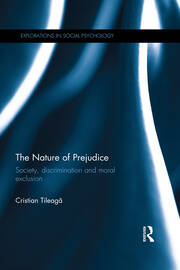
The Nature of Prejudice Society, discrimination and moral exclusion
By Cristian Tileagă
Copyright 2016
184 Pages
by
Routledge
184 Pages
by
Routledge
184 Pages
by
Routledge
Also available as eBook on:
This book offers a critical synthesis of social psychology’s contribution to the study of contemporary racism, and proposes a critical reframing of our understanding of prejudice in European society today. Chapters place a special emphasis on the diversity and intensity of prejudices against Romani people in a liberal, progressive, decent, enlarged Europe. Chapters ask how we can reconcile the... Read more
1. From antipathy to indignity: a framework for critical analysis 2. Stereotypes, new racism and the changing nature of marginality in Europe 3. Personality and racism as predisposition 4. Social categorization and contexts of social identity 5. The discourse of prejudice: racism as discursive ideology 6. Beyond stereotypes: moral transgression and being ‘out of place’ 7. Dehumanization and moral exclusion 8. Towards a critical social psychology of racism
Biography
Cristian Tileagă is Senior Lecturer in Social Psychology and member of the Discourse and Rhetoric Group at Loughborough University, UK.
"Using the example of the Roma (or Gypsies) in Europe, Cristian Tileagă in The Nature of Prejudice: Soceity, Discrimination and Moral Exclusion not only successfully challenges psychologists to incorporate societal and cultural perspectives and approaches in analyses of prejudice but also presents a wide-ranging analysis of prejudice as moral devaluation that gives discourse analysis a central, defensible role. A new framework is developed of prejudice as the personal, social, and cultural means by which dignity and worth are denied to particular groups of 'others'. It should appeal to advanced students and researchers in social psychology who recognize the value of exploring old problems from new interdisciplinary perspectives... The range of theoretical and empirical material Tileagă engages with in the book is impressive and well balanced. The argument is compelling and the analysis overcomes many of the traditional biases and barriers in psychology to rigorous and innovative affective, discursive, social, and cultural analysis. This is an important contribution to the ilterature on prejudice from a European perspective, which has valuable lessons for researchers from other parts of the world and neighboring discplines such as sociology and anthropology." - Gavin Brent Sullivan, PsycCritiques
