




1st Edition
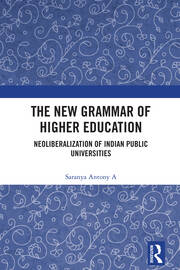
The New Grammar of Higher Education Neoliberalization of Indian Public Universities
List of Tables viii Acknowledgments ix 1 Introduction 1 2 The Gurukulam to Colonial Imprints: Shaping Higher Education System in India 20 3 Architects of Change: Post-Independence Reforms and the Vision of Indian University System 50 4 The Neoliberal Turn in Universities in India 69 5 Dissecting Disparities in Indian Universities: Challenges to Accessibility, Affordability, and Equity 90 6 Conclusion: Agitate, Organize, Reclaim—The Continuing Battle for the University 113 References 130
Biography
Saranya Antony A is Assistant Professor in the Department of Political Science, Easwari School of Liberal Arts, SRM University–AP, Andhra Pradesh. She holds a PhD and an MPhil from the Centre for Russian and Central Asian Studies, School of International Studies, Jawaharlal Nehru University (JNU), New Delhi, and a master’s degree in politics with a specialization in international studies from JNU.
During her doctoral research, she was awarded the Erasmus+ Fellowship and studied at Kaunas University of Technology, Lithuania.
Dr. Antony has previously served as a guest faculty in the Department of Politics and International Studies at Pondicherry University. Before that, she worked as a research fellow in political theory and constitutional law at the Lal Bahadur Shastri National Academy of Administration (LBSNAA), Mussoorie. Prior to that, she served as an assistant professor at the Government College of Arts and Science, Androth Island, Lakshadweep.
Her areas of interest include higher education, Indian polity, caste and social justice, international politics, gender and intersectionality, the Baltic states, and the Russia–Ukraine conflict.
