





1st Edition
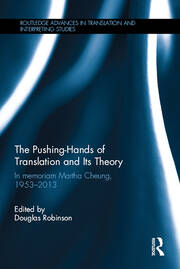
The Pushing-Hands of Translation and its Theory In memoriam Martha Cheung, 1953-2013
Editor's introduction: pushing hands with Martha Cheung
Part 1: Backgrounds
1. "The medited nature of knowledge and pushing-hands approach to research on translation history", Martha P.Y. Cheung
2. "Pushing Hands with Martha Cheung: The Genealogy of a Translation Metaphor", Sean Golden
3. "Towards a yin-yang poetics of translation: Tai Chi pushing-hands, hao-ran zhi qi, and pure language", Chunshen Zhu
Part 2: Practical Applications
4. "Tuishou: a theoretical framework for (re)translation history?", Marie-France Guenette
5. "Pushing Hands, the invisible hand, and the changing (pre-)faces of the baihua Chinese Translations of The Wealth of Nations", Andy Lung Jan Chan
6. "Pushing papaer, pushing hands, pushing the envelope: Three Eleanors (Arts as Historiography) as theatrical trasnlation across media", Dorothy Chansky
7. "The Pushing-hands Approach to Translation Practice: A Case Study of Team Translation of A Full Load of Moonlight by Mary M.Y. Fung and David Lunde", Gloria K.K. Lee
8. "Translation Paratexts and the Pushing-Hands Approach to Translation History", Kathryn Batchelor
Part 3: Theoretical Applications
9. "Applying the ‘Pushing-Hands Approach’ to a Dialogue among Microhistory, Macrohistory and Histoire Croisée", Judy Wakabayashi
10. "Conceptualizing pushing-hands in translation studies: a Heideggerian perspective", Jiang Chengzhi
11. "Pushing-Hands and Periperformativity", Douglas Robinson
Biography
Douglas Robinson is Dean of Arts and Chair Professor of English at Hong Kong Baptist University. A scholar of language, literature, translation, and rhetoric and a translator from Finnish to English since 1975, he is author most recently of Schleiermacher’s Icoses (Zeta Books, 2013), The Dao of Translation (Routledge, 2015), The Deep Ecology of Rhetoric in Mencius and Aristotle (SUNY Press, 2015), and Semiotranslating Peirce (Tartu Semiotics Library, 2015). His current project is an English translation of Finland’s greatest novel, Aleksis Kivi’s Seven Brothers (1870).
"As a balancing and rebalancing of different forces involved in translation to avoid or reduce confrontation, this book of collected essays opens up an exciting way of thinking about how the "pushing-hands" approach can be further explored and extended and developed by uncovering the mediating translator’s dialogic engagement and providing a model for working across temporal and cultural differences in producing carefully balanced translations." – Sun Yi-feng, Professor, Lingnan University
