




4th Edition
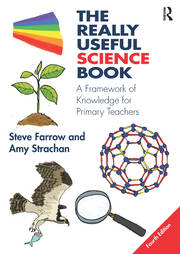
The Really Useful Science Book A Framework of Knowledge for Primary Teachers
Section One - Introduction
Section Two - Biology
Key Idea 2.1 - The characteristics of living things
Key Idea 2.2 - Life processes
Key Idea 2.3 - Optimum conditions for survival
Key Idea 2.4 - The variety of life
Key Idea 2.5 - Adaptation to environment
Key Idea 2.6 - The transfer of energy
Section Three - Chemistry
Key Idea 3.1 - The particulate nature of matter
Key Idea 3.2 - The classification of materials
Key Idea 3.3 - Changing materials
Key Idea 3.4 - The rock cycle
Key Idea 3.5 - The water cycle
Section Four - Physics
Key Idea 4.1 - Sources and forms of energy
Key Idea 4.2 - Forces
Key Idea 4.3 - The Earth and beyond
Biography
Steve Farrow was Senior Lecturer in Science Education in the School of Education at Durham University, where he was also director of Primary ITT programmes.
Amy Strachan is Senior Lecturer in Primary Science Education at St Mary’s University, Twickenham, UK. She has more than 10 years of experience as Head of Science in international, state and independent schools and has produced teacher materials for both the BBC and Oxfam.
The structure of this book is great: sectioned into biology, chemistry and physics, it is easy to navigate. . .and key ideas - for example, key idea 2.6 lists: energy transfer, food chains and webs, and the food cycle - demonstrate a natural link between topics, useful for planning for progression.
At the end of each section, the National Curriculum programme of study guides display progression through year groups, offering an ‘at a glance’ view of what pupils’ prior knowledge should be and what they are aiming towards. The teaching idea boxes reveal great ideas to use as ‘awe and wonder’ activities and hooks, and the concept confusion boxes are really easy to use; allowing teachers to identify common misconceptions that may occur during the lesson.
I really enjoyed the famous scientist fact-boxes, they are relevant, linking concepts and topic areas to scientists and allowing children to see where theories and ideas originate and that they are developing and changing.
Finally, working scientifically is an excellent feature of the book; for a teacher or trainee teacher, this ensures and reassures us that the children in our class are achieving all the different aspects of working scientifically.
- Anna Porto, Third Year Undergraduate Primary Science Education Specialist, St. Mary’s University, UK
