




1st Edition
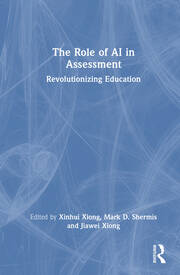
The Role of AI in Assessment Revolutionizing Education
Acknowledgements
Notes on the Contributors
Foreword by Richard J. Patz
1. Introduction to Artificial Intelligence in Educational Assessment
Xinhui Xiong
2. Ethical Considerations and Challenges in AI-Based Educational Assessment
Matthew S. Johnson, Ikkyu Choi, and Andrew McEachin
3. The Evolution of Assessment with AI Technologies
Mark D. Shermis
4. A Call for Transparency in the Development and Validation of AI-Based Writing Evaluation Systems
Sue Lottridge and Amy Burkhardt
5. Personalization in Assessment to Optimize Engagement and Performance
Burcu Arslan, Randy E. Bennett, Sandip Sinharay, Jesse R. Sparks, and Kadriye Ercikan
6. Modern NLP Pipeline in Educational Measurement: From Text Analysis to Scoring and Reasoning
Constanza Mardones-Segovia, Yaxuan Yang, Cheng Tang, Jiawei Xiong, Shiyu Wang, and Allan S. Cohen
7. Rapid Item Generation and the Revolutionary Impact of Generative AI
Kimberly Swygert, Tahereh Firoozi, and Mark Gierl
8. Measuring Learning through Play: AI-Enabled Game-Based Assessment
Xinhui Xiong and Deniz Eseryel
9. Large Language Models in Assessment
Christopher Ormerod, Alexander Kwako, Kai North, and Sue Lottridge
10. Machine Learning–Based Methods for Cheating Detection in Large-Scale Assessments
Hong Jiao, Jiawei Xiong, and Chandramani Lnu
11. International Work in AI for Educational Assessment
Hongyun Liu, Yongmei Zhang, and Fang Luo
12. Key Considerations for Assessing and Supporting Collaboration with AI
Peter W. Foltz
13. The Impact of Artificial Intelligence on Validity and Test Validation
Stephen G. Sireci, Sergio Araneda, and Javier Suárez-Álvarez
14. The Transformative Potential of AI in Large-Scale Assessments
Ummugul Bezirhan and Matthias von Davier
Index
Biography
Dr. Xinhui Xiong is a chief psychometrician at Examroom AI and holds a PhD in Psychometrics from Fordham University, an MLA in Management from Harvard University, and a Master’s degree in Computer Science. Her work centers on scalable, defensible assessment design, including validation, equating, fairness analysis, and test security. She has published in leading journals and presented extensively at national and international conferences on measurement.
Dr. Mark D. Shermis was the principal investigator and academic adviser for the Automated Student Assessment Prize (ASAP). He is currently a consultant for Performance Assessment Analytics, LLC. Dr. Shermis has also held faculty and administrative positions at multiple universities. He is a frequently cited expert on machine scoring and co‑editor (with Dr. Joshua Wilson) and author of The Routledge International Handbook of Automated Essay Evaluation.
Dr. Jiawei Xiong is a research scientist at Curriculum Associates. He earned his PhD in Educational Psychology (Quantitative Methodology) from the University of Georgia. He has co‑edited multiple volumes, published widely, and contributed to numerous national and state assessment and learning programs. He is the recipient of the Brenda H. Loyd Outstanding Dissertation Award from the National Council on Measurement in Education.
‘This volume offers a strong and diverse collection of chapters on the possibilities of AI in educational assessment. Its impressive breadth addresses many critical issues in this emerging field and highlights promising directions for leveraging AI to advance personalized, adaptive, and scalable assessment.’
Jeff Douglas, University of Illinois
‘This is an exciting and timely book that summarizes contemporary perspectives on the use of AI in assessment. It is safe to say it is a “revolution” – it remains to be seen if AI is an angel of salvation or a temptress and deluder. This book contributes in a meaningful way to discussions of the application of AI in educational assessment.’
George Engelhard, Jr., The University of Georgia
‘Speaking as a psychometrician, this is the book I’ve been waiting for! AI is clearly a critical part of the future of educational assessment. Many important issues are addressed in the book’s chapters, including equity, validity and test security, making it a comprehensive resource for many audiences in the field.’
Charles Lewis, Fordham University
‘Rarely is a book more perfectly timed for publication than this one. The winds of change stirred by developments in AI bring great opportunities to educational assessment but also potential risks. Readers of this volume will be better equipped to navigate the challenges posed by AI and make the most of its possibilities.’
Mary J. Pitoniak, Pitoniak Educational Measurement LLC
