





1st Edition
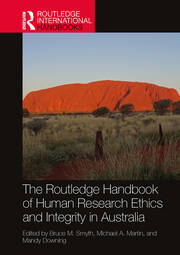
The Routledge Handbook of Human Research Ethics and Integrity in Australia
PART ONE: SETTING THE SCENE
1. Human Research Ethics and Integrity: A Tale of Respect, Merit, Justice, and Beneficence
Michael A. Martin, Bruce M. Smyth and Mandy Downing
2. Research Integrity in the Australian Research Landscape: Reflections and a Plan for Action
Douglas W. Robertson
3. Exploring and Managing Questionable Research Practices
Nitya Phillipson
4. Human Research Ethics Committees: Friend or Foe?
Nathan Emmerich
5. Legal Dimensions of Human Research Ethics
Graeme Blank
PART TWO: ETHICAL RESEARCH WITH ABORIGINAL AND TORRES STRAIT ISLANDER PEOPLES
6. Indigenous Research Ethics in the Australian Context: A Brief Introduction
Mandy Downing
7. Relevant Codes, Protocols, and Guidelines in the Context of Indigenous Research
Ed Wensing
8. The AIATSIS Code of Ethics for Aboriginal and Torres Strait Islander Research
Sara Tomkins and Angus Harden
9. On the Importance of Respectful Engagement with Australia’s Aboriginal and Torres Strait Islander Peoples
Ed Wensing
10. Protecting Indigenous Cultural and Intellectual Property in Research Collaboration
Terri Janke
PART THREE: PRIMING ETHICAL PERSPECTIVES—EARLY CONSIDERATIONS
11. Researcher Safety and Welfare
Bruce M. Smyth and Michael A. Martin
12. Moral Injury in Research and the Responsibility of Ethics Committees
Adam Henschke
13. What’s the Point of Participant Information Sheets If No-One Reads Them?
Sheri Kim
14. Are We Paying Participants Enough, and When and How Should We Pay?
Gordon Waddington
PART FOUR: RESEARCH METHODS AND ETHICS
15. Ethics in Quantitative Research: Commissions and Omissions
Michael Smithson
16. Randomised Controlled Trials and Quasi-Experimental Designs
Nicholas Biddle and Katherine Curchin
17. Interviews, Focus Groups and Yarning: Some Associated Ethical Challenges
Bruce M. Smyth, Michael A. Martin and Mandy Downing
18. The Ethics of Archiving and Sharing Qualitative Data
Kate O’Connor, Julie McLeod and Nicole J. Davis
PART FIVE: ETHICS ACROSS VARIED SETTINGS AND DISCIPLINES
19. The Ethics of Contemporary Criminal Justice Research
Natalia Hanley and Jason Payne
20. ‘This Is Doin’ My Head In’: The Ethics of Psychological Research
Alison L. Calear, Alyssa R. Morse and Michelle Banfield
21. Ethno+Graphy and Research Ethics in Australia
Caroline E. Schuster
22. The Ethics of Gambling Research
Aino Suomi
23. The Ethics of Socio-Legal Research
Felicity Bell and Faith Gordon
24. Pandemic and Public Health Emergency Ethics
Gordon Waddington
PART SIX: FAMILIES, CHILDREN, AND OLDER AUSTRALIANS
25. Qualitative Research with Couples and Families: Six Ethical Issues
Bruce M. Smyth, Lawrence J. Moloney and Banu B. Moloney
26. Research with Children: Balancing Protection and Participation
Sharon Bessell
27. Ethics of Research with Older Australians
Yvonne Wells and Deirdre Fetherstonhaugh
PART SEVEN: DIGITAL DATA, ARTEFACTS, AND SECURITY
28. Ethics Clearance for Digital Humanities
Terhi Nurmikko-Fuller
29. Ethical Issues in Human Research with Technology
Elizabeth T. Williams and Jennyfer L. Taylor
30. Ethics of Research Using Digital Trace Data: A Computational Social Science Perspective
Robert Ackland and M. Francisca Bórquez Vivanco
31. Cybersecurity Research and Society: Considerations for Researchers and Human Research Ethics Committees
Jayson S. Lamchek and Shiri Krebs
32. Data Management Plans: A Risk-Informed Approach
Keith Bolland, Bruce M. Smyth and Terhi Nurmikko-Fuller
PART EIGHT: OTHER THORNY ISSUES
33. Catching the Call: Dealing with Whistleblowing While Doing Research
Adam Masters
34. Research Supervision: The Ethics of the Student–Supervisor Relationship
Justine Rogers
35. Publication Ethics and Peer Review
Patrick Kilby
Biography
Bruce M. Smyth is Professor of Family Studies with the Centre for Social Research and Methods at the Australian National University, Canberra, Australia.
Michael A. Martin is Professor of Statistics in the School of Finance, Actuarial Studies and Statistics at the Australian National University, Canberra, Australia; and Chair of the Human Research Ethics Committee at the Australian National University.
Mandy Downing is a Ngarluma Yindjibarndi woman and an Associate Professor with Curtin University in Western Australia, Australia; Co-Chair of the National Research Ethics Committee at the Australian Institute of Aboriginal and Torres Strait Islander Studies; and the Dean of Indigenous Futures at Curtin University.
"This handbook is a must-read for seasoned researchers and those at the dawn of their research careers. It is an essential addition to every researcher’s toolkit, especially in the ethical conduct of Indigenous research." -- Professor Mick Dodson AM, FASSA, The Australian National University, Australia
"This edited volume is an important and timely examination of a subject which has never been more critical. It is an indispensable resource for those concerned with ensuring researcher and participant safety and embedding ethical conduct into all aspects of academic practice." -- Dr Kylie Moore-Gilbert, Author of The Uncaged Sky: My 804 days in an Iranian prison
"Researchers and their institutions have underinvested in exploring those questions of ethics and integrity specific to social research in Australia. This collection is a welcome initiative to stimulate our ethical imagination and share better practices in the face of institutional risk aversion, chronic under-resourcing, funders’ demands for social impact, emergent methodologies, the possibilities of two-way learning with Indigenous communities, challenges to data security and privacy, swift technological change, and the pressures of social exclusion." -- Professor Mark Israel, Australasian Human Research Ethics Consultancy Services
"It is important to have an on-going diverse set of discussions regarding ethical practices as risk tolerance, norms and expectations change over time within universities, disciplines, and cultures. Ethical oversight in practice, and implementation, can often reflect personal perceptions and values of what constitutes ‘good’ research by oversight committee members rather than the application of a genuine principles-based approach. This compendium attempts to grapple with this conundrum by covering a broad range of disciplines, methods and lived experiences. It demonstrates that in practice a rules-based approach to ethical oversight lacks the flexibility to include emerging and diverse cultural, methodological, and disciplinary contexts and this runs the inherent risk of closing off challenging and new research in an increasingly complex, fast paced, culturally challenging world." -- Emeritus Professor Toni Makkai, The Australian National University, Australia
