



1st Edition
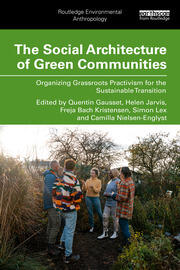
The Social Architecture of Green Communities Organizing Grassroots Practivism for the Sustainable Transition
The social architecture of green communities: An introduction
Quentin Gausset, Helen Jarvis, Simon Lex, Freja Bach Kristensen, Camilla Nielsen-Englyst
1. People-powered green placemaking in the United Kingdom: Multi-level strategies and a theory of change
Helen Jarvis
2. Eros unredeemed: Post-patriarchal soft power and inclusivity in the Tamera and Monte Verità communities
Ana Margarida Esteves
3. Majority-rule, sociocracy and do-ocracy: Micropolitics in Danish green communities
Quentin Gausset, Camilla Nielsen-Englyst
4. Communes, eco-villages, eco-habitats, and alternative networks: A typology of green communities and the role of subsistence in ecological living
Ieva Snikersproge
5. The social architecture of constructive disobedience: Collective resistance in the Danish energy transition
Simon Lex
6. Applying participatory methods of green communities to transform rurban areas of Northwestern Germany
Anne-Kathrin Schwab
7. The practices of sharing: Negotiating spaces and things in three intentional community case studies
Penny Clark
8. Communitarian ‘Inhabiting’: Empathic forms and conflict resolution spaces
Sylvia Amar
9. Sustainability brokering and green community building in Danish social housing
Freja Bach Kristensen
10. Slow practivism: Volunteering in Dutch urban gardens
Cristina Grasseni
11. Community gardens and the act of food sharing: The impact of community engagement
Susan Andreatta
Conclusion: Lessons learned from the social architecture of green communities
Anne-Kathrin Schwab, Quentin Gausset, Helen Jarvis, Simon Lex, Freja Bach Kristensen, Camilla Nielsen-Englyst
Biography
Quentin Gausset received his PhD in anthropology from the Free University of Brussels and is Associate Professor in Anthropology at the University of Copenhagen. He has 30 years of experience with interdisciplinary research on natural resource management and environmental conflicts, based on fieldworks in Africa, South-East Asia and Denmark.
Helen Jarvis is a UK based scholar-activist who has enduring interests in the lived realities of communal living, such as cohousing, and grassroots socio-spatial interventions that align social and environmental justice with green sharing economies. Since 2024, Helen has continued to publish and campaign for social and ecological justice as an independent scholar consultant, with Professor Emeritus status.
Simon Lex is Deputy Head of Education and Associate Professor at the Department of Anthropology, University of Copenhagen. His primary research interests are within climate, organizational and business anthropology. He is a PI of the Grand Solution project “DART: The Danish Model for Citizen Engagement in the Renewable Energy Transition” and co-editor of the Journal of Business anthropology.
Freja Bach Kristensen is a PhD fellow at the Department of Anthropology and is specialized in the fields of urban anthropology, community development and the green transition. She has extensive experience with civil society collaborations both within and outside academia having worked as a consultant within urban development and citizen involvement for more than 7 years.
Camilla Nielsen-Englyst holds a degree in Educational Studies from Roskilde University and is a grassroots activist rooted in the ecovillage and cohousing movements. For the past decade, her work has focused on connecting research, development, and practice.
