





1st Edition
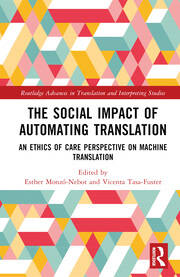
The Social Impact of Automating Translation An Ethics of Care Perspective on Machine Translation
Contents
List of Contributors
Acknowledgements
1. Interconnected, Dependent, and Dependable Translation Automation: Toward an Ethics of Care in Machine Translation
Esther Monzó-Nebot & Vicenta Tasa-Fuster
2. The Cultural Roots of Translation Automation: Revealing Ideologies in Machine Translation
Esther Monzó-Nebot
3. Harmful Effects of Machine Translation and Their Mitigation: A Preliminary Taxonomy
Mikel L. Forcada
4. Risks for Lay Users in Machine Translation and Machine Translation Literacy
Lynne Bowker
5. Unmasking Indigenous Invisibility: Empowering AI‑Driven Translation with Indigenous Participation
Aline Larroyed, Adriano da Silva & Sharon O’Brien
6. Gender Bias in Translation Automation: Addressing Bias and Inequality
Marta García González
7. Artificial Intelligence in Healthcare Translation: A Contemporary Systematic Review
Vanessa Enríquez-Raído
8. Democracy, Artificial Intelligence, and Machine Translation: Some Legal Challenges
Vicenta Tasa-Fuster
9. Machine Translation, Large Language Models, and Generative AI in the University Classroom: Toward a Pedagogy of Care
Sourojit Ghosh & Srishti Chatterjee
10. In Different Voices: The Roles of Public Machine Translation Studies
Esther Monzó-Nebot
Index
Biography
Esther Monzó-Nebot is Associate Professor in Translation and Interpreting Studies in the Department of Translation and Communication Studies at Universitat Jaume I, Spain.
Vicenta Tasa-Fuster is Lecturer of Constitutional Law in the Department of Constitutional Law and Political Science and Administration at Universitat de València, Spain.
"Ultimately, The Social Impact of Automating Translation serves as a call to action for scholars, practitioners, and policymakers to reimagine the development and deployment ofMT systems. By centering care ethics and critically challenging dominant ideologies, the collective volume offers a framework for fostering inclusivity, equity, and democratic values. Readers are encouraged to build on the insights offered in this volume, transforming its vision into tangible actions that shape a more just and inclusive future for translation technologies."
María Lomeña-Galiano, Université de Rennes
"Through in-depth case studies and critical analyses, the authors of this volume shed light on the often- overlooked consequences of MT. This exploration is not only timely but also crucial for shaping a more equitable future for translation technology. Overall, this book is highly recommended for anyone interested in understanding the social implications of MT and the challenges and opportunities it presents."
Lisheng Liu, Xuchang University, Digital Scholarship in the Humanities
"[…] this is an important and highly relevant work that succeeds in expanding the ethical vocabulary through which translation automation is understood."
Daniele Duscovich (PhD candidate at Alma Mater Europaea, Austria)
