




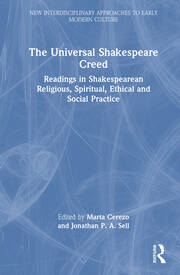
1st Edition
The Universal Shakespeare Creed Readings in Shakespearean Religious, Spiritual, Ethical and Social Practice
Acknowledgements
List of Contributors
Note on texts
Introduction. Marta Cerezo Moreno and Jonathan P. A. Sell
Part One. ‘In the beginning’
Chapter One. Establishing the Shakespeare Creed: Religion, Class and Enlightenment bardolatry. Jonathan P. A. Sell
Chapter Two. ‘A radiant light of glory round’: Stratford-upon-Avon Shakespeare Festivities, Religion and Universality (1830-1850). Marta Cerezo Moreno
Chapter Three. Religion and Tolerance in Danish and Swedish Shakespeare Criticism, 1880–1960. Per Sivefors
Part Two. ‘Speaking in our tongues’
Chapter Four. Isis and Osiris: Antony and Cleopatra. Graham Holderness
Chapter Five. The Deceitful Brahman: The Veil of Maya in The Tempest. Antonio Ballesteros
Chapter Six. Shakespeare’s Bodhisattvas: A Buddhist Approach to Spiritual Disease, Medicine and Caregiving in King Lear. Marguerite Tassi
Chapter Seven. The Mustard Seed and the Dionysian in A Midsummer’s Night Dream. Unhae Park Langis
Part Three. ‘Go ye into all the world’
Chapter Eight. ‘Civic Shakespeare’: Intermission Youth Theatre, Faith, and Social Commitment. Isabel Guerrero
Chapter Nine. Facing the Storm with Love: A Church Liturgy based on Shakespeare’s play The Tempest. Paul Fiddes
Chapter Ten. ‘Something pretty in words that fly’: Psalmic Performances from Shakespearean Romance to Rhiannon Giddens’s Omar. Julia Reinhart Lupton
Chapter Eleven. The Shakespearean and Biblical Intertexts of Emily St. John Mandel’s Station Eleven. Luis Javier Conejero-Magro
Selected Index
Biography
Marta Cerezo is Professor of English Literature at the UNED (National University of Distance Education, Spain) Her current area of research is devoted to Shakespeare and religion and, most especially, to the Shakespeare commemorative sermons delivered at Holy Trinity Church (Stratford-upon-Avon) since the nineteenth century. She is Chief Editor of Sederi Yearbook, the journal of the Spanish and Portuguese Society for English Renaissance Studies. She leads the UNED research group ELSSO (English Literary Studies in Society) and is currently the Principal Investigator of the Research Project PID2021-123341NB-I00 ‘Shakespeare’s Religious Afterlives: Text, Reception, and Performance’ (SHAKREL).
Jonathan P. A. Sell is Professor of English Literature at the Universidad de Alcalá, Spain. His principal fields of research are early modern literature, Shakespeare and literary aesthetics. His publications include Rhetoric and Wonder in English Travel Literature, 1560-1613 (Ashgate, 2006; Routledge, 2019) and the prize-winning, two-part essay on the Shakespearean sublime, Shakespeare’s Sublime Ethos: Matter, Stage, Form (Routledge, 2022) and Shakespeare’s Sublime Pathos: Person, Audience, Language (Routledge, 2022).
‘The Universal Shakespeare Creed edited by Marta Cerezo Moreno and Jonathan P. A. Sell is a uniquely brave experiment that brings the religious thematics of recent Shakespeare studies to its most ambitious final test: it explores the global afterlife of Shakespeare’s plays for such implied religious values that may blur the boundaries of all established denominations from the past yet can contribute to the spiritual healing of our torn and turmoiled present.’
Péter Dávidházi, Eötvös Loránd University
‘In a world that can seem riven by enmity, this remarkable collection of essays is a timely reminder that the greatest art communicates and connects across boundaries, including apparently profound differences of religious belief. Across a wide range of deeply informed and imaginative readings, the authors reclaim an idea of ‘universality’ at risk of being irreparably discredited by dominant trends in academic criticism. The result is illuminating, provocative and heartening. They have given renewed life to a Shakespeare for our troubled times.’
Adrian Poole, Trinity College, Cambridge
‘Thomas Carlyle called ‘Dante the melodious Priest of Middle-Age Catholicism’ but ‘Shakespeare the still more melodious Priest of a true Catholicism, the “Universal Church” of the future and of all times’. This brave, stimulating and wide-ranging book begins to work out what that means. It inaugurates a new field of Shakespeare’s religious afterlives. And it does so in a convulsed and polarised world that is desperate for community-reconfiguring and peace-giving truths.’
Ewan Fernie, The Shakespeare Institute, University of Birmingham
