





1st Edition
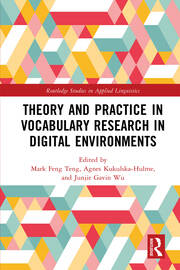
Theory and Practice in Vocabulary Research in Digital Environments
Contents
List of figures
List of contributors
Acknowledgements
Preface
1. Introduction to Theory and Practice in Vocabulary Research in Digital Environments
Mark Feng Teng and Junjie Gavin Wu
Part I
Theories and synthesis
2. Intentional vocabulary learning through captioned viewing: Comparing Vanderplank’s ‘cognitive-affective model’ with Gesa and Miralpeix
Robert Vanderplank and Mark Feng Teng.
3. Mapping the digital game-based vocabulary learning landscape: A comprehensive bibliometric exploration
Zhaoyang Xiong, Junjie Gavin Wu,,and Di Zou
4. Development of gloss studies in vocabulary learning research
Makoto Yoshii
Part II
Pedagogical practices
5. A corpus-based study of learners’ language learning trajectories with captioned viewing: Implications for vocabulary learning practices
Mark Feng Teng and Jesse W. C. Yip
6. L2 vocabulary learning with an AI chatbot: From linguistic, affective, and cognitive perspectives
Sangmin-Michelle Lee
7. Training to use machine translation for vocabulary learning
Yijen Wang and Glenn Stockwell
8. Korean EFL learners’ vocabulary development through asynchronous CMC and synchronous CMC in content courses
Sung-Yeon Kim
9. The anatomy of word lists in New Word Level Checker: Description and comparison
Atsushi Mizumoto
10. Mobile-assisted vocabulary learning in an EAP context
Jeong-Bae Son and Sang-Soon Park
11. Vocabulary learning with Netflix: Exploring intraformal learning practices through the lens of Complex Dynamic Systems Theory
Antonie Alm and Yuki Watanabe
12. Using TikTok for vocabulary learning: Multimodal implications
Yeong-Ju Lee
13. Conclusion: The next generation of studies in multimodal, multilingual, and multi-agent vocabulary learning
Agnes Kukulska-Hulme
Index
Biography
Mark Feng Teng is an Associate Professor in Applied Linguistics at Macao Polytechnic University, China.
Agnes Kukulska-Hulme is a Professor of Learning Technology and Communication in the Institute of Educational Technology at the Open University, UK.
Junjie Gavin Wu is a Lecturer and a Ph.D. Supervisor at Macao Polytechnic University, China.
"A diverse and exciting collection of approaches to vocabulary acquisition in the “digital wild” - this book should be useful to everyone involved in technology-enhanced language learning."
- Hilary Nesi, Professor in English Language, Research Centre for Arts, Memory and Communities, Coventry University
