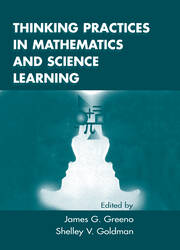
The term used in the title of this volume--thinking practices--evokes questions that the authors of the chapters within it begin to answer: What are thinking practices? What would schools and other learning settings look like if they were organized for the learning of thinking practices? Are thinking practices general, or do they differ by disciplines? If there are differences, what implications... Read more
The term used in the title of this volume--thinking practices--evokes questions that the authors of the chapters within it begin to answer: What are thinking practices? What would schools and other learning settings look like if they were organized for the learning of thinking practices? Are thinking practices general, or do they differ by disciplines? If there are differences, what implications do those differences have for how we organize teaching and learning? How do perspectives on learning, cognition, and culture affect the kinds of learning experiences children and adults have?
This volume describes advances that have been made toward answering these questions. These advances involve several agendas, including increasing interdisciplinary communication and collaboration; reconciling research on cognition with research on teaching, learning, and school culture; and strengthening the connections between research and school practice.
The term thinking practices is symbolic of a combination of theoretical perspectives that have contributed to the volume editors' understanding of how people learn, how they organize their thinking inside and across disciplines, and how school learning might be better organized. By touring through some of the perspectives on thinking and learning that have evolved into school learning designs, Greeno and Goldman begin to establish a frame for what they are calling thinking practices. This volume is a significant contribution to a topic that they believe will continue to emerge as a coherent body of scientific and educational research and practice. Read less
Contents: Introduction. S.V. Goldman, J.G. Greeno, Thinking Practices: Images of Thinking and Learning in Education. Part I: Participation and Identity in Practice.M.K. Stein, E.A. Silver, M.S. Smith, Mathematics Reform and Teacher Development: A Community of Practice Perspective. M. Lampert, Studying Teaching as a Thinking Practice. J. Greeno, Trajectories of Participation and Practice: Some Dynamic Aspects for the Thinking Practices of Teaching, Educational Design, and Research. L. Godfrey, R.P. Moses, M.C. O'Connor, The Missing Data Point: Negotiating Purposes in Classroom Mathematics and Science. S.L. Star, Leaks of Experience: The Link Between Science and Knowledge. P. Eckert, Entitled to Know. Part II: Accomplishing Thinking Practices.A.A. diSessa, J. Minstrell, Cultivating Conceptual Change With Benchmark Lessons. A. Rubin, R. Hall, ...There's Five Little Notches in Here: Dilemmas in Teaching and Learning the Conventional Structure of Rate. G.B. Saxe, S.R Guberman, Emergent Arithmetical Environments in the Context of Distributed Problem Solving: Analyses of Children Playing an Educational Game. S. Goldman, Researching and Revisiting the Thinking Curriculum. M. Lynch, D. Macbeth, Demonstrating Physics Lessons. A.H. Schoenfeld, Making Mathematics and Making Pasta From Cookbook Procedures to Really Cooking. R. McDermott, V. Webber, When Is Math or Science? A.L. Brown, S. Ellery, J.C. Campione, Creating Zones of Proximal Development Electronically. M. Riel, Learning Communities Through Computer Networking. A. Collins, Learning Communities: A Commentary on Papers by Brown, Ellery, and Campione, and by Riel.
Biography
James G. Greeno, Shelley V. Goldman
"Fresh and clear perspectives are needed to study and interpret the complex world of teachers' and children's thinking as they communicate about and learn mathematics and science. The editors and authors of this book have succeeded in bringing together a diverse and important set of ideas that can provide these new perspectives. The use of social interaction theories appears to have promise for guiding the analysis and interpretation of the rich and complex data that arises from classroom observations, videotape studies, interviews, and similar research methods." —Mathematical Thinking and Learning
Customer preferences like text size, font type, page color and more.
Take annotations in line as you read.
Multiple eBook Copies
This eBook is already in your shopping cart. If you would like to replace it with a different purchasing option please remove the current eBook option from your cart.
Book Preview
Pre-Order Notification
We're sorry, your request could not be processed
Success! We will email you once this format of the book is available for pre-order.
The country you have selected will result in the following:
Product pricing will be adjusted to match the corresponding currency.
The title Perception will be removed from your cart because it is not available in this region.