





1st Edition
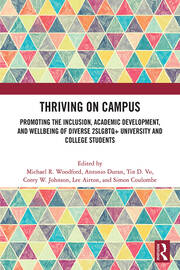
Thriving on Campus Promoting the Inclusion, Academic Development, and Wellbeing of Diverse 2SLGBTQ+ University and College Students
Foreword: Toward queer thriving
Kristen A. Renn and Ángel de Jesus Gonzalez
Introduction – Thriving on campus: Promoting the inclusion, academic development, and wellbeing of diverse 2SLGBTQ+ university and college students
Michael R. Woodford, Antonio Duran, Tin D. Vo, Corey W. Johnson, Lee Airton and Simon Coulombe
1. Queer crip enrollments: 2SLGBTQ mad, mentally ill, neurodivergent, and/or disabled college students
Andrew J. Ives and Becki Elkins
2. They don’t owe you their story: conceptualizing racialized queer care through protective spaces
Christina B. Arayata and Vanessa Vigneswaramoorthy
3. Queering racialized designations: centering queer and trans Latine students at an emerging Hispanic serving institution (eHSI)
Gabi C. Ortiz
4. Identifying stressors inhibiting belonging, visibility, and peer inclusion for college students with MIoSG in STEM
Annemarie Vaccaro, Orianna D. Carvalho, Meg C. Jones, Ryan A. Miller, Desiree Forsythe, Rachel E. Friedensen and Rachael Forester
5. The mental health needs of sexual and gender minority collegiate clients at university counseling centers
Lisa F. Platt, Christine J. Schimmel, Jeneice Shaw and Christopher P. Scheitle
6. Examining campus support systems for LGBQ+ college students’ mental health and well-being
Steven Feldman and Allison BrckaLorenz
7. ‘I have had several providers who recognize my humanity’: exploring the overall health and positive healthcare interactions of transgender and gender diverse college students
E. B. Gross, Shanna K. Kattari, Monique Steel, Rachelle Wilcox, Susan Ernst and Diana Parrish
8. Environmental and individual predictors of resilience for queer-spectrum college students
Benjamin P. Correia-Harker, Mary Joy Hickey, Max Herteen and Kya Ione Ohlson
9. Belongingness, connectedness & engagement: the impacts of an LGBTQ + residential learning community
Brittanie Atteberry-Ash, Jessica R. Williams, Hayden T. DuBois and Beth Pearson
10. Students’ perceptions of all-gender restrooms after implementation
Anna Pope and Jacob Randall
Innovative Practices
11. Practical insights from the Human Rights Campaign’s HBCU PrEP peer educator program
Jarrel T. Johnson, Leslie D. Hall and Raphael D. Florestal-Kevelier
12. Queer and trans Black, Indigenous, and people of color (QTBIPOC): the sun of LGBTQ + rainbow
Trung M. Nguyen and Cindy Konrad
13. Queer umbrella: a student-employee collaboration to enhance 2SLGBTQ+ well-being and belonging
Quinn Hafen, Shiloh Dailey, Jordan Brooks and Jennifer Currin-McCulloch
14. School of social welfare transgender justice group: student-led advocacy to promote justice and equity for gender diverse college students
Emera Greenwood, Allison Colonna, Dani Novo, Samantha Walter, Eli Shafaf, Briana McGeough and Megan S. Paceley
15. Three years of Camp Qmunity: an interdisciplinary LGBTQIA + summer intensive program
Archana A. Pathak and Maurice N. Gattis
16. Beyond gender inclusive housing: building a trans and nonbinary residential experience
Christopher C. Stone-Sewalish
17. The misgendering and deadnaming survey: an innovative, co-designed campus change project to catalyze improvement
Chris Woods and Allison J. Smith
Biography
Michael R. Woodford (he/him/his), PhD, Professor, Lyle S. Hallman Faculty of Social Work, Wilfrid Laurier University. Michael’s research centers on the inclusion and wellbeing of 2SLGBTQ+ communities, primarily focusing on campus climate, microaggressions, and resilience. Recently, he led the Thriving On Campus project, engaging nearly 3900 2SLGBTQ+ students across Ontario. Committed to social justice, Michael’s research prioritizes identifying actionable change to foster students’ belonging and flourishing.
Antonio Duran (he/him/his), PhD, Associate Professor, Higher and Postsecondary Education, Arizona State University. Antonio’s research involves understanding how historical and contemporary legacies of oppression influence college student development, experiences, and success. In particular, he is passionate about uplifting the perspectives of queer and trans communities of color, as well as theories and frameworks grounded in these experiences.
Tin D. Vo (he/they), PhD, Assistant Professor, Factor-Inwentash Faculty of Social Work, University of Toronto. Tin’s interdisciplinary, equity-focused research centers on social climate and exclusion as determinants of health. Using a critical lens, his research evaluates policies and systems and explores intersectional lived experiences of historically marginalized communities to enhance their belonging and wellbeing in various contexts, including 2SLGBTQ+ leisure spaces and higher education institutions.
Corey W. Johnson (he/him/his), PhD, Karla Henderson Distinguished Professor of Social Justice, Department of Park, Recreation and Tourism Management, College of Natural Resources, North Carolina State University. Corey’s scholarship focuses on power relations between dominant and non-dominant populations. He has received substantial support to create safer environments for 2SLGBTQ+ youth in camps, secondary schools, universities, and detention centers. He is also a qualitative methodologist with several books on the subject, including Fostering Social Justice through Qualitative Inquiry.
Lee Airton (they/them), PhD, Associate Professor, Gender and Sexuality Studies in Education, Faculty of Education, Queen’s University. Lee’s research explores how Canadian schools and teacher education integrate gender identity and gender expression human rights. The second edition of their book Gender: Your Guide – The Gender-Friendly Primer on What to Know, What to Say and What to Do in the New Gender Culture was released in 2024.
Simon Coulombe (he/him/his), PhD, Associate Professor, Industrial Relations Department, Université Laval. Intersecting several fields of psychology, Simon’s research aims to explore factors that could be leveraged to promote the positive wellbeing of people, particularly those from marginalized groups, including 2SLGBTQ+ students. At Laval, he holds the Relief Research Chair in Mental Health, Self-Management, and Work.
Despite the unwelcoming climate for 2SLGBTQ+ students at many colleges and in about half of US states, they can flourish, and Thriving on Campus provides valuable insights into how 2SLGBTQ+ students can succeed and how faculty and staff can support their wellbeing and academic achievement. The impressive breadth and depth of this book—with articles focused on areas like racialized queer spaces, campus housing, all-gender restrooms, misgendering and deadnaming, STEM programs, and counseling centers—make it a must-read for people in higher education.
Genny Beemyn, PhD, editor, Trans People in Higher Education, Director, the Stonewall Center, University of Massachusetts, Amherst
------------------------------
This book offers an important and timely contribution to the literature about 2SLGBTQ+ college students. The chapters center wellness and resilience for 2SLGBTQ+ communities, which is a welcome disruption to the anti-trans and anti-queer narratives saturating political discourse. I was inspired by the breadth of experiences, identities, and perspectives within the book that challenge assumptions about 2SLGBTQ+ students and nuance how we engage in transformative practice. Analyses are informed by critical frameworks and counternarratives that illustrate how institutions frequently harm rather than heal. Higher education administrators, practitioners, mental health providers, and faculty will find insightful guidance for policy and practice from this text.
Melvin A. Whitehead, PhD, Assistant Professor, Higher Education and Student Affairs, College of Community and Public Affairs, Binghamton University
------------------------------
Woodford, Duran, Vo, Johnson, Airton, Coulombe, and the authors have produced an impactful collection that will make meaningful and sustaining waves across colleges and universities for 2SLGBTQ+ students. Rarely does a volume of work speak so strongly across sectors, including policy, advocacy and solidarity, and student success. What I find particularly remarkable is the collective focus on thriving, encouraging me and other readers to center joy, opportunity, and liberation among 2SLGBTQ+ people and communities. I am grateful for both the process and product of their collaboration and will be sure to share widely among stakeholders in higher education with solidarity, appreciation, and love.
Jason C. Garvey, PhD, Executive Director, Office of Institutional Research and Assessment, Friedman-Hipps Green and Gold Associate Professor of Education, University of Vermont
------------------------------
Thriving on Campus serves as an essential resource for all who care about improving the conditions of 2SLGBTQ+ student livingness. Taking an expansive perspective as to who 2SLGBTQ+ students are and an affirmative approach to the places, spaces, practices, and resistant modes of collective worldbuilding, this book is a critical text. Kudos must go to the editors and authors who collaborated on this project; may we all be steadfast in enacting the policies and practices that aid in 2SLGBTQ+ students continuing to thrive as a result of their tremendous efforts.
Z Nicolazzo, PhD, Associate Professor, University of Arizona
------------------------------
As a scholar-practitioner, this is the book I have been waiting for! Thriving on Campus: Promoting the Inclusion, Academic Development, and Wellbeing of Diverse 2SLGBTQ+ University and College Students centers the lives and stories of 2SLGBTQ+ students at the margins of the margins and offers actionable insights for how to serve and support their flourishing. I am excited to use this text in my practice and share it with my team and campus partners as we strive for a more just and equitable campus. With chapters from some of the most brilliant and trusted voices in the field, I believe this book has the potential to significantly shift both research and practice.
Jesse L. Beal, MA, Director, Spectrum Center, University of Michigan, PhD Candidate, Michigan State University
