





1st Edition
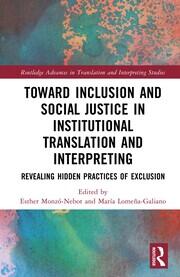
Toward Inclusion and Social Justice in Institutional Translation and Interpreting Revealing Hidden Practices of Exclusion
List of Contributors
Introduction
1. Inroads Into Unchartered Spaces in Institutional Translation and Interpreting Studies.
Esther Monzó-Nebot
Section I: Revealing Oppression in and through Translation and Interpreting
2. Deterrence Through Lack of Linguistic Access Within the US Immigration Deportation System Laura Belous & Jaime Fatás-Cabeza
3. Linguistic and Epistemic Discrimination Against Migrants in Italian Asylum Procedures. Maurizio Veglio
4. Hidden Patterns in Interpreting Xenophobic Discourse in The European Parliament. Barbara Hinterplattner
Section II: Revealing and Debunking Myths
5. Implementing Gender-Fair Language in International Organizations: Collective Illusions and Gender Bias in Translation Sections. Esther Monzó-Nebot & Helen Debussy
6. A Project for Making Interpreters’ Silent Knowledge Heard. Kristina Gustafsson, Eva Norström & Linnéa Åberg
7. “We Sold We Were Perfect.” Revealing Health Risks for Translators and Interpreters at International Organization. Esther Monzó-Nebot
Section III: Revealing Translation and Interpreting in Institutional Spaces
8. Conference Signed Language Interpreting Services at International Organizations: Breaking the Barriers. Maya de Wit
9. Overcoming Language Barriers in Belgium: Enhancing Communication in Prisons to Facilitate Successful Reintegration? Heidi Salaets, Jonathan Bernaerts & Shanti Heijkants
10. Being Protected, Feeling Autonomous. Workplace Values in The Translation Culture of The Language Interpreting Office (Spanish Ministry of Foreign Affairs). Nuria Brufau
Conclusions
11. Taking Stock and Chartering the Territories of Institutional Translation and Interpreting. Esther Monzó-Nebot & María Lomeña-Galiano
Index
Biography
Esther Monzó-Nebot is an associate professor in translation and interpreting in the Department of Translation and Communication at Universitat Jaume I, Spain.
María Lomeña-Galiano is an associate professor in translation studies in the Department of Foreign Languages and Translation at Université Rennes 2, France.
"This volume could be regarded as a call to action, not only for the institutions themselves to pay proper attention to redressing these inadequacies, but also for further research into thecontrast between stated objectives and actual outcomes, stakeholders’ attitudes towards the delivery (and deliverers) of these services, and possible solutions
to the problems and challenges identified."- Holly Mikkelson, Middlebury Institute of International Studies at Monterey, United States of America
