




1st Edition
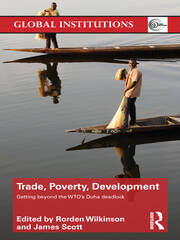
Trade, Poverty, Development Getting Beyond the WTO's Doha Deadlock
Introduction: The promise of "development" and the Doha Development Agenda James Scott and Rorden Wilkinson Part I:The Round 1. The poverty of the Doha round and the least developed countries James Scott and Rorden Wilkinson 2. The Doha Development Agenda ten years on: What next? Bernard Hoekman Part II: Key Issues 3. Food security and the WTO Jennifer Clapp 4. Poverty and cotton in the DDA Donna Lee Part III: The View from Inside 5. The changing global economy, Africa and the DDA Ujal Singh Bhatia 6. Mandela’s way: Reflections on South Africa’s role in the multilateral trading system Faizel Ismail and Brendan Vickers 7. Africa and the promise of the Doha round Yonov Frederick Agah 8. The Doha round and the future of the WTO Sun Zhenyu Focus on Africa 9. Some consequences of trade liberalization in sub-Saharan Africa Jomo Kwame Sundaram 10. Africa and the Doha round Richard E. Mshomba 11. The Doha Development Agenda: Prospective outcomes and African perspectives Pradeep Mehta, Bipul Chatterjee and Joseph George 12. The Doha Development Agenda and the WTO can deliver on Africa’s development priorities Peter Draper, Memory Dube and Morisho Nene
Biography
Rorden Wilkinson is Professor of Global Political Economy and Head-elect Department of International Relations, University of Sussex, UK.
James Scott is Hallsworth Research Fellow with the Brooks World Poverty Institute at the University of Manchester.
