




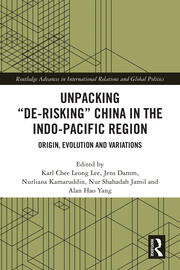
1st Edition
Unpacking "De-risking" China in the Indo-Pacific Region Origin, Evolution and Variations
List of Contributors
Introduction
Karl Chee Leong Lee & Jens Damm
1. De-Risking China: The Evolution of European Strategic Thinking (2019–2024)
Nur Shahadah Jamil & Alfred Gerstl
2. United States and De-risking China
Mark Bryan Manantan
3. Germany’s Strategic Balancing Act: Navigating Economic Dependence and Systemic Rivalry with China
Jens Damm
4. China’s Mitigation of Chips-Derisking by the West (the United States, the Dutch and Chips4)
Tai Wei Lim
5. Japan’s Evolving Approach to Economic Security under U.S.-China Rivalry: A Departure from the Pacifist State?
Masahiro Matsumura
6. Navigating Risk: South Korea’s Strategic Approach to China
Nurliana Kamaruddin & Sophie J. Lee
7. De-risking China: Taiwan as Method
Alan Hao Yang
8. Between Security and Economics: India’s De-risking Strategy towards China
Sana Hashmi
9. Indonesia’s Responses to ‘De-risking’ China vis-à-vis the United States and Its Allies: The Nexus of Domestic and International Interest
Ali Maksum
10. In the Dragon’s Shadow: How Has Vietnam’s Selective “De-risking” Strategy Played Out?
Huynh Tam Sang
11. Malaysia’s Multi-alignment Approach to “De-risking” China Wave: The Quest for Semiconductor Powerhouse
Hong Lip Goh & Karl Chee Leong Lee
Conclusion
Nurliana Kamaruddin & Nur Shahadah Jamil
Index
Biography
Karl Chee Leong Lee is a Senior Lecturer for the Institute of China Studies (ICS), University of Malaya; an Advisor to Taiwan Chamber of Commerce in Malaysia (TWCHAM); and Editor-in-Chief for the Scopus-indexed International Journal of China Studies (IJCS). A Taiwan scholar on a myriad of research areas, his research interests include Taiwan–Southeast Asia overall relations, Taiwan’s New Southbound Policy (NSP), semiconductor geoeconomics and economic–technological statecraft (ETS).
Jens Damm is an Associate Fellow at the European Research Center on Contemporary Taiwan (ERCCT), Eberhard Karls University, Tübingen, Germany. His research interests include the new media and the Internet, China’s soft power and gender studies.
Nurliana Kamaruddin is a Senior Lecturer at the East Asian Studies Department, Faculty of Arts and Social Science, Universiti Malaya. She is also a Fellow at the Centre for Asia-Europe Institute (AEI). Her research interests include international security and development with a focus on East Asia and specifically Malaysia–Korea relations.
Nur Shahadah Jamil is a Senior Lecturer at the Institute of China Studies (ICS), University of Malaya (UM). Having received a PhD in Strategic and Security Studies from the National University of Malaysia (UKM), her research concentrates mainly on China’s foreign policy, South China Sea, Southeast Asian responses to the Belt and Road Initiative and East Asian Security.
Alan Hao Yang is a Distinguished Professor of Southeast Asian Studies at the Graduate Institute of East Asian Studies (GIEAS) and Deputy Director of the Institute of International Relations (IIR) at National Chengchi University (NCCU), Taiwan. He has been engaging in track II diplomacy and currently works as the Executive Director for NCCU’s Center for Southeast Asian Studies, which served as the secretariat of the Consortium for Southeast Asian Studies in Asia (SEASIA). His research interests cover International Relations and regionalism in Southeast Asia, environmental governance and disaster resilience, border politics, resistance politics in Southeast Asia, foreign policy and soft power analysis with a specific focus on China’s Confucius Institute and Taiwan’s New Southbound Policy (NSP).
