





1st Edition
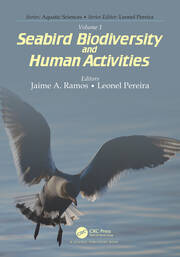
Volume 1: Seabird Biodiversity and Human Activities
Part A: Techniques to Study Seabirds
1. An Introduction to Seabirds and Their Study
Marie Claire Gatt, José Pedro Granadeiro and Paulo Catry
2. Conventional and Modern Approaches to Study Seabird Trophic Ecology and Diet
Filipe R. Ceia, José C. Xavier, Ana R. Carreiro, Ivo dos Santos and Yves Cherel
3. A Physiological Toolbox to Explore the Relationships Between Seabirds and Their Changing Environments
Ana Cláudia Norte, Pedro Miguel M. Araújo and David Costantini
4. Tracking Seabirds for Conservation and Marine Spatial Planning
Jorge M. Pereira, Vitor H. Paiva, Lucas Krüger and Stephen C. Votier
Part B: Seabirds Interacting with Human Activities and Infrastructures
1. Seabird and Fisheries Interactions
Nuno Oliveira, Jaime A. Ramos, Joana Gomes Calado and José Manuel Arcos
2. Urban Gulls Living with Humans
Joana Pais de Faria, Catarina S. Lopes, Edward Kroc, Louise K. Blight and Ruedi G. Nager
3. Seabirds and Marine Renewable Energy Sources
Andrew J.P. Harwood and Sue King
4. Seabirds and Biotoxins
María Victoria M. Casero, Jaime A. Ramos and Leonel Pereira
Part C: Seabirds as Ecological Indicators
1. Seabirds as Indicators of Forage Fish Stocks
Jaime A. Ramos and Robert W. Furness
2. Seabirds as Indicators of Oceanographic Changes
Vitor H. Paiva
3. Seabirds as Indicators of Metal and Plastic Pollution
Catarina S. Lopes, Maria I. Laranjeiro, Jennifer L. Lavers, Annett Finger and Jennifer Provencher
4. Antarctic Seabirds as Indicators of Climate Change
José C. Xavier, Richard A. Phillips and Akinori Takahashi
Part D: Actions for Seabird Conservation
1. Light Pollution as a Seabirds’ Conservation Threat
Cátia S.A. Gouveia
2. Eradication and Control of Invasive Mammal Species as a Seabird Conservation Tool
Paulo Oliveira, Félix M. Medina, Manuel Nogales and Pedro Luís Geraldes
3. Identifying and Establishing Marine Protected Areas Worldwide: The Contribution of Seabird Data
Lucas Krüger
Biography
Jaime A. Ramos is Associate Professor at Coimbra University, Portugal, where he teaches Conservation Biology and Ecology, and is a member of MARE, the Marine and Environmental Sciences Centre. He has worked with seabirds for over 25 years in the Atlantic and Indian Oceans and published over 200 papers in international journals. He leads a team of researchers and students using Conservation Physiology, Diet, Habitat Selection, and Movement Ecology to study the ecology of marine top predators for biodiversity conservation and environmental management.
Leonel Pereira, the coordinator of the Aquatic Sciences Series to which this volume belongs to, has a PhD in Biology by the University of Coimbra, Portugal, where he currently lectures. He is also an Investigator integrated in MARE, the Marine and Environmental Sciences Centre. His interests are mainly focused on Marine Biodiversity, Marine Biotechnology and Marine Ecology (environmental assessment). He has authored/edited more than 40 books and book chapters, and published more than 100 scientific papers in international journals.
