




1st Edition
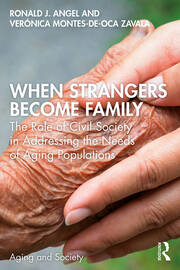
When Strangers Become Family The Role of Civil Society in Addressing the Needs of Aging Populations
1. Struggling Collectively for Truth and Justice
2. Defamilisation and the Welfare State
3. Elder Rights in the Context of the New Human Rights Discourse
4. Active Aging and Citizenship
5. The Political and Legal Contexts of Eldercare in Mexico
6. Labor Unions and the Struggle for Political Power
7. Improving the Quality of Life
8. The Expanding Human Rights Agenda
9. Illiberal Democracy and the Future of Civil Society
Biography
Ronald J. Angel is Professor of Sociology at the University of Texas-Austin and coauthor, along with Jacqueline L. Angel, of Family, Intergenerational Solidarity, and Post-Traditional Society and Latinos in an Aging World.
Verónica Montes-de-Oca Zavala is Professor of Sociology and Demography at the Universidad Nacional Autónoma de México (UNAM). She is the author of Envejecimiento en América Latina y el Caribe. UNAM and Oxford Institute of Ageing Population.
In Mexico, as elsewhere, longer lifespans, together with shorter health spans, decreasing fertility and deep social changes result in an increasing number of vulnerable and dependent older adults, whose fate, in the context of the COVID-19 pandemic is severely compromised. This book offers very timely and comprehensive insights into the roles of civil society organizations in advocating and providing services to this population as they defend the human and social rights of older persons.
Luis Miguel Gutiérrez, Director, Instituto Nacional de Geriatría, México
In When Strangers Become Family the authors highlight the roles of Civil Society Organizations in promoting care services in improving quality of life in old age, from a rights-based perspective, by promoting the new human rights agenda embodied in all international conventions since the World Assembly of Aging held in Madrid.
Gloria Fernández-Mayoralas, Investigadora senior del Consejo Superior de Investigaciones Científicas, Madrid, Spain
This investigation focuses on diverse groups and their mission toenhance the quality of life of older people. Highlighted are three large groups: labor unions, groups that focus on quality of life of older people, and other groups that are guided by the ongoing struggle to protect human rights in later life.
Maria Aranda, Associate Professor at the University of Southern California Suzanne Dworak-Peck School of Social Work, and Executive Director of the USC Edward R. Roybal Institute on Aging, USA
An outstanding question since the emergence of mass society has been how government, public and private interest groups could organize to mitigate the hardships of people needing moral support and material assistance when intimate social networks are unable to adequately respond. This volume examines this dilemma through the lens of surging numbers of aging dependent people confronted with resource scarcity and provides insights and opportunities that transcend the geographic boundaries of the author's contextual analysis.
William Vega, Emeritus Provost Professor at the University of Southern California and former Executive Director of the USC Roybal Institute on Aging, USA
