





1st Edition
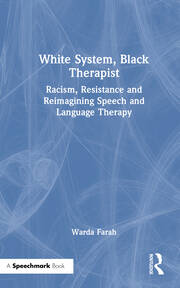
White System, Black Therapist Racism, Resistance and Reimagining Speech and Language Therapy
Foreword by Aris Moreno Clemons
Foreword by Tasha Austin
INTRODUCTION
Before He Was Understood, He Was Measured
Mr. Grammarticologylisationalism Is the Boss
Lord Lexicon and the Ministry of Misdiagnosis
Credentialed, But Conditional
Complain, Complain, Complain…
Too Brilliant, Too Black, Too Much
We Were Already Guilty, Just Waiting for the Complaint
Speaking Up While Black
The Frameworks We Inherit, The Futures We Imagine
PART 1
The Politics of Storytelling: Unveiling What Has Always Been
The Disorder Was in the Assessment, Not the Child
Awakenings
The Biopolitics of Voice
Costumes and Corrections: The Early Policing of Voice
Activism or Survival?
One Thoughtful Step at a Time
PART 2
There Is No Racial Justice Without Linguistic Justice
The Issue With Membership Organisations – My Opinion
George Floyd
Aversive Racism
Academia and Research
A Personal Snapshot
Naming the Divide
Environments Matter
Labour in Speech and Language Therapy
The Matrix of Constant Replacement
Communal Lament and Quantum Entanglements
Toward Linguistic and Racial Liberation
So, Where Do We Go From Here?
PART 3
A Critical Reflection on the Foundations of Speech-Language Therapy
A Lens That Narrows Rather Than Illuminates
Whose Language Is ‘Standard’?
Epistemic Violence and the Politics of Knowledge
The Bell Curve Baby
From Critical Reflection to Ethical Transformation
Radical Listening, Ethical Commitment
Decolonising Speech Language Therapy
What Is Decolonisation?
Critical Race Theory
Paving the Way for Transformative Change
Five Foundational Concepts for Decolonising Speech-Language Therapy
Embracing the Power of Conversations
RCSLT Summer 2024
It’s Not Just the RCSLT
The Urgency of Structural Overhaul
Moving Beyond Rhetoric to Real Change
The Legacy of Orlando Taylor
The Essential Shift Required
The Power of Sisterhood, Spirituality and Divine Order
Self-Check for Genuine Solidarity
Blackness as a Commodity
Speaking Up Is Professional
PART 4
Language as Our Most Powerful Tool for Creation
The Weight of Language and the Question of Practice
30 Million Word Gap
Confronting the Limitations of Standardised Assessment
The Sociohistorical Roots of Standardised Testing & Eugenics
Colonial Legacies in Language Norms
Linguistic Justice Across Space, Time, and Lineage
Time for Testimonies
Testimony: Omari
What Are Testimonies
Therapist's Role in Facilitating Testimonies
Learning from Testimonies
One Last Testimony
When Language Becomes a Site of Surveillance
The Myth of the Neutral Professional
Leo’s Story
My Reflections
Noah’s Story
Critical Reflections for Practitioners
Muhammad’s Story
Critical Reflections for Practitioners
Training Practitioners in Critical Reflexivity
CONCLUSION
Unbecoming, and Imagining Something New
Embracing Uncertainty
The Inclination to Categorise and Compartmentalise
Reinterpreting Our Values in New Ontologies
An Overreliance on Standardised Testing
“I Don’t See Colour”
Independent Scholars Matter
Racial Ignorance
Protecting Professional Whiteness
Language as Core Value
Political Identity and Blackness as a Site of Transformation
Creating a More Expansive, Liberatory Praxis
Three Vital Questions
An Alternative Vision Rooted in Agency
Cultivating Collective Strength and Joy
Why Don’t You Cite Us?
A Philosophical Approach to Praxis
Decolonise, Destroy and Dream: Thought Experiments
Not “Hard to Reach,” but Deliberately Erased
Power at the Core
Being and Becoming
How do we use our present awareness to inform and shape a better future?
Coloniality of Power
Genuine Liberation Matters
Envisioning a New World
The Emergence of Spaces of Reprieve
Index
Biography
Warda Farah is a multi‑award‑winning social entrepreneur, speech and language therapist, writer, and lecturer whose work bridges neurodiversity research and racial justice. She founded Language Waves to work in a culturally, linguistically, and neurodiversity affirming manner, and collaborates with teachers and schools to rethink received wisdom and developmental theories shaping education in the UK.
"Based on my first reading of this book, I found it excellent. It forced me to think more deeply about several issues--and to be introduced to several that I have never focused on, and had limited understanding of! Farah offers vitally important insights, all of critical importance to our communities in Britain. Her work is an open challenge to those who hold positions of influence, even authority, but whose views have long past their expiry date. Frankly, it brings me personal joy to read Farah’s work, and to deepen my understanding of many matters of critical importance. I wish her great success! She deserves it, for the service she is providing to our children and parents. Keep it up!" - Bernard Coard, Guest Lecturer and Author
"This is a book where the personal and the political entangle to bring a fresh perspective on the experiences of children and professionals in educational and language intervention settings. With generosity, candour and wit, Warda shares her experiences training and working in the SLT sector, whilst gesturing towards a better, decolonised way of doing this work. This book is a must read for anyone who went into an educational / caring / health profession hoping to make the world a better place; it prompts us to self-reflect and ask critical questions about the assumptions underpinning our work, and what they may be reproducing, marginalising or Affirming." - Professor Abigail Hackett, Sheffield Hallam University
"Warda’s timely and important book pushes us all to reflect on how interlocking systems of whiteness, ableism, coloniality, and racial capitalism are pervasive in speech and language therapy. Her core argument is that this is no accident or mistake – it is by design. She shows how contemporary speech and language therapy assessment instruments, policies, and practices are built on colonial logics which systematically exclude linguistically-marginalised communities. Theoretically rich, methodologically rigorous, and beautifully written, it draws on Warda’s own lived experience on linguistic pathologisation from inside the very system of speech and language therapy itself. But this is not just about re-documenting existing harms – it’s about pushing for futures of linguistic justice within speech and language therapy, and imagining entirely different and more equitable worlds. It is a must read for all speech and language therapy practitioners, but especially those who continue to be complicit in maintaining its white supremacist foundations." - Dr Ian Cushing, Senior Lecturer in Critical Applied Linguistics, Manchester Metropolitan University, UK
