





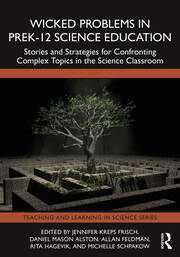
1st Edition
Wicked Problems in PreK-12 Science Education Stories and Strategies for Confronting Complex Topics in the Science Classroom
Introduction
Allan Feldman & Molly Nation
Part 1: PreK-12 Students
Chapter 1 - Nature-Based Learning and Supportive Learning Environments: A Pathway to Climate Change Education and Social Justice
Syaza Soraya Sauli & Nur Syazadiyanah Suraini
Chapter 2 - School STEAM Garden-Based Learning Empowering Students to BEE Environmental Ambassadors
Michelle Parslow, Rita Hagevik, Kathy Cabe Trundle, & Katherine N. Vela
Chapter 3 - Addressing Wicked Problems Using Multiple Models
Jamie Elsner & Troy Sadler
Chapter 4 - Creating Environmental Impact Statements as a Tool to Improve Student Understanding of Complex Ecological and Environmental Issues
Jessica Amacher & Sarah O’Leary-Driscoll
Chapter 5 - Building Perceptional Progression Among Adolescents Concerning Climate Impacted Coastal Resilience in Economically Divergent Communities
Timothy A. Goodale
Part 2: Inservice Teachers
Chapter 6 - Understanding the Impact of a Contentious Sociopolitical Landscape on Science Teachers’ Practice and Well-being
Shannon G. Davidson & Daniel R. Pimentel
Chapter 7 - “This Isn’t A Crime, This Is Science”: How Carceral Logics have Manifested In Science Education
Maizie Dyess
Chapter 8 - Addressing Gender Inequity Through Sexual and Reproductive Health Education: An Indian Perspective
Sushma Sardana & Ginaya Littlejohn
Chapter 9 - Teaching about the Wicked Problem of Global Climate Change in Secondary Science
Molly Nation & Allan Feldman
Chapter 10 - Building District-Level Capacity in the Development and Implementation of NGSS-Aligned, Justice-Centered Curriculum
Elizabeth Chatham, Devin Foschi, Joy Otibu, & Andrea Sau
Part 3: Teacher Candidates
Chapter 11 - “Yeah, that’s racist”: Reflections and learnings from a justice-oriented lesson gone wrong
David Steele & Imogen Herrick
Chapter 12 - Utilizing model-eliciting wicked problems in STEM teacher education: A path from learning to serving
Michelle Schpakow & Vecihi S. Zambak
Chapter 13 - Cultural contexts and global challenges: Integrating science and social sciences in Omani teacher preparation programs
Mohamed A. Shahat & Saif Al-Maamari
Chapter 14 - We Make the Road by Walking: Supporting Science Teacher Candidates’ Moves Toward Justice-Oriented Teaching and Learning
Daniel Alston & Lenora Crabtree
Part 4: Science Teacher Educators
Chapter 15 - Developing an Ecological Worldview for Teacher Candidates Through Authoring Children’s Science Stories
E.J. Bahng & Athena Hui Jiang
Chapter 16 - Be Like Fungi: Mycorrhizal Pedagogy
Jennifer Kreps Frisch, Suki Jones Mozenter, Mandy Bogle, Olive Hollander, Liz League, & Josh South
Chapter 17 - Addressing Power in the Collaborative Design Process while Building Transdisciplinary Perspectives on Energy Independence in the Arctic
Jeffrey L. Spencer & Ginger V. Shultz
Chapter 18 - Tackling Wicked Problems through Teacher-Researcher Collaboration and Codesign
Doriana Sportelli, Christina Siry, & Sara Wilmes
Chapter 19 -Transdisciplinary Pedagogies in Pre-Service Teacher Preparation to Address Wicked Problems
Holly Plank & Hillary Chelednik
Chapter 20 - Wicked Orientations in Teacher Preparation: The Complexity of Cultivating Anti-Racist Science Teachers
Kathryn M. Bateman, Jonathan D. McCausland, & Brandon Sherman
Biography
Jennifer Kreps Frisch is an Associate Professor in the Department of Education at University of Minnesota Duluth, USA.
Daniel Mason Alston is an Associate Professor in the Cato College of Education at the University of North Carolina at Charlotte, USA, and the director for the Charlotte Teaching Fellows Program.
Allan Feldman is Emeritus Professor of Science Education in the College of Education at the University of South Florida, USA.
Rita Hagevik is Professor and Director of Graduate Programs in Science Education in the Biology Department at UNC-Pembroke, USA.
Michelle Schpakow is the Science Education Lecturer for Monmouth University’s School of Education, USA.
