




1st Edition
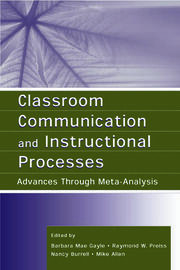
Classroom Communication and Instructional Processes Advances Through Meta-Analysis
472 Pages
by
Routledge
466 Pages
by
Routledge
224 Pages
by
Routledge
Also available as eBook on:
This volume offers a systematic review of the literature on communication education and instruction. Making meta-analysis findings accessible and relevant, the editors of this volume approach the topic from the perspective that meta-analysis serves as a useful tool for summarizing experiments and for determining how and why specific teaching and learning experiences have positive student... Read more
Contents: B.M. Gayle, Preface. Part I: Classroom Communication and Instructional Processes. R.W. Preiss, M. Allen, Meta-Analysis, Classroom Communication, and Instructional Processes. J.C. McCroskey, V.P. Richmond, L.L. McCroskey, The Role of Communication in Instruction: The First Three Decades. Part II: Educational Practices in the Classroom. C. Rich, B.M. Gayle, R.W. Preiss, Pedagogical Issues Underlying Classroom Learning Techniques. S.J. Berkowitz, Developing Critical Thinking Through Forensics and Communication Education: Assessing the Impact Through Meta-Analysis. E.J. Shapiro, J. Kerssen-Griep, B.M. Gayle, M. Allen, How Powerful is PowerPoint? Analyzing the Educational Effects of Desktop Presentational Programs in the Classroom. C.E. Timmerman, K.A. Kruepke, Comparisons of College Student Performance Across Computer-Assisted and Traditional Instruction Formats. R.W. Preiss, B.M. Gayle, M. Allen, Test Anxiety, Academic Self-Efficacy, and Study Skills: A Meta-Analytic Review. N.A. Burrell, C.S. Zirbel, M. Allen, Evaluating Peer Mediation Outcomes in Educational Settings: A Meta-Analytic Review. Part III: Classroom Interactions. J. Kerssen-Griep, B.M. Gayle, R.W. Preiss, Classroom Interaction and Educational Outcomes. P.L. Witt, L.R. Wheeless, M. Allen, The Relationship Between Teacher Immediacy and Student Learning: A Meta-Analysis. L. Bradford, E. Cooper, M. Allen, J. Stanley, D. Grimes, Race and the Classroom: Interaction and Image. S.M. Jones, K. Dindia, S. Tye, Sex Equity in the Classroom: Do Female Students Lose the Battle for Teacher Attention? J. Bourhis, M. Allen, I. Bauman, Communication Apprehension: Issues to Consider in the Classroom. M. Allen, J. Bourhis, E. Mabry, N.A. Burrell, C.E. Timmerman, Comparing Distance Education to Face-to-Face Methods of Education. L.M. Timmerman, Family Care Versus Day Care: Effects on Children. Part IV: Teacher Effectiveness and Communicative and Instructional Processes. D. Cortez, B.M. Gayle, R.W. Preiss, An Overview of Teacher Effectiveness Research: Components and Processes. B.M. Gayle, R.W. Preiss, M. Allen, How Effective Are Teacher-Initiated Classroom Questions in Enhancing Student Learning? D.M. Martin, R.W. Preiss, B.M. Gayle, M. Allen, A Meta-Analytic Assessment of the Effect of Humorous Lectures on Learning. R.W. Preiss, B.M. Gayle, Exploring the Relationship Between Listening Comprehension and Rate of Speech. R.W. Preiss, B.M. Gayle, A Meta-Analysis of the Educational Benefits of Employing Advanced Organizers. M. Allen, Relationship of Teaching Evaluations to Research Productivity for College Faculty. Part V: Meta-Analysis and Interactional and Instructional Process in the Classroom. B.M. Gayle, The Contributions of the Scholarship of Teaching and Learning. S.L. Young, T.G. Plax, P. Kearney, How Does Meta-Analysis Represent Our Knowledge of Instructional Communication? J.L. Applegate, Why SoTL Matters: Knowing What We Need to Know to Make Sure Our Students Learn What They Need to Know to Succeed as Citizens. M. Allen, R.W. Preiss, N.A. Burrell, What to Do in the Classroom? Evaluating the Advice.
Biography
Barbara Mae Gayle, Raymond W. Preiss, Nancy Burrell, Mike Allen
"The various chapters provide excellent overviews of the particular constructs examined through meta-analysis. The challenges of conducting research related to these constructs are clearly delineated. Studies used in various meta-analyses are clearly indicated so that other scholars can easily access empirical studies on a topic. The referencing is extensive and provides a comprehensive introduction to the field of communication education."
—PsycCRITIQUES
