




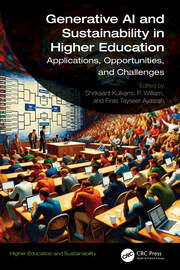
1st Edition
Generative AI and Sustainability in Higher Education Applications, Opportunities, and Challenges
Preface
About the Editors
List of Contributors
1 Bridging Education and Industry: Ethical Implications and Opportunities of Generative AI
Naaz Gorowara, Bikashdev Chhura, Nidhi Yadav, Tripti, Rajni, and Khaleel Al-Said
2 Generative AI in Higher Education: Advancing Pedagogical Innovation and Addressing Emerging Challenges
Suprina Sharma, Monika Aggarwal, Harleen Kaur, Madhuri Aggarwal, Rohit Markan, and Khaleel Al-Said
3 Transforming Curriculum Development in Higher Education through Generative AI
Khaleel Al-Said, Firas Tayseer Ayasrah, Rajanikanth Aluvalu, P. William, and Edeh Michael Onyema
4 AI-Driven Economic Intelligence for Emerging Market Education Systems
Rohit Markan, Lakshmipathi K N, Mutyala Subramanyam, Anil Sharma, Pankaj Chhuttani, and Khaleel Al-Said
5 Fostering Critical Feedback and Evaluation Competencies in Students With Generative AI
Anurag Shrivastava, P. Ravi Kumar, Santiago Otero-Potosi, Santiago López Chamorro, Nidal Al Said, and Ramy Riad Al-Fatlawy
6 Innovative Applications of Generative AI in Career Planning for Vocational Education
Deepali Singh, Vandana Madaan, Monika Aggarwal, Shobha Yadav, Paramveer Singh, and Firas Tayseer Ayasrah
7 Exploring ChatGPT’s Potential for Professional Development in Higher Education Contexts
Mayank Bharadwaj, Sakshi Verma, Deepali Singh, Paramveer Singh, and Anjali Singh
8 AI-Driven Hiring Practices: Student Perceptions, Ethical Dilemmas, and Workforce Implications
Anurag Shrivastava, RVS Praveen, Mohsin Shaikh, Laith Hussein Jasim, Sneh Binod Prasad, and Arti Badhoutiya
9 Safeguarding Student Privacy in AI-Driven Educational Ecosystems: Ethical Perspectives
Firas Tayseer Ayasrah, Khaleel Al-Said, Rajanikanth Aluvalu, P. William, and Edeh Michael Onyema
10 AI and Data Privacy: Analyzing Ethical Impacts in Secondary Education in India
Jigisha Srivastava, Shresth Kumar, Prabhat Kr. Dwivedi, Manu Priya Gaur, Ankit Garg, and Haayder M. Abbas
11 Sustainable Lifelong Learning: Leveraging AI to Redefine Pedagogical Approaches
Prem Kumar Sholapurapu, Abdul Rasheed P, Sheela Hundekari, Heba Abdul-Jaleel Al-Asady, Anurag Shrivastava, and Kanchan Yadav
12 Sustainability in Campus Operations: Data-Driven Evaluation of College Initiatives
Sheela Hundekari, RVS Praveen, Anurag Shrivastava, Saif O. Husain, Rakesh Kumar, and Sorabh Lakhanpal
13 Designing Comprehensive Environmental Sustainability Frameworks for Higher Education
Long Tam Pham, Bikashdev Chhura, Lubna Sadaf Naqvi, Anshul Pardesi, and Seema Sharma
14 Ethical and Privacy Challenges in Artificial Intelligence: Implications for Education
Sadhana Vadhawani Bajaj, Neha Verma, Sarjue Pandita, Ankit Garg, Aboothar Mahmood Shakir, and Neeraj Varshney
15 Equity, Transparency, and Privacy in AI-Enhanced Education: An Ethical Analysis
Mohammad Ahmar Khan, Surbhi Khanna, Rohit Markan, Anupama Sharma, and Pankaj Chhuttani
Index
Biography
Dr. Shrikaant Kulkarni is a research professor at Sanjivani University, India, and an adjunct professor at the Victorian Institute of Technology, Melbourne, Australia, and Lincoln University College, Malaysia. Dr. Kulkarni has been a senior academician and researcher for four decades. He has over 100 research publications to his credit in national and international journals, and he has authored over 100+ book chapters and 60+ edited books published by reputable publishers. He has expertise in materials science, green chemistry and engineering, analytical chemistry, green nanoscience, nanotechnology, and AI. He was invited by the United Nations to deliver a talk on green chemistry education for sustainable development at the International Conference in Green Chemistry held in Bangkok, Thailand.
Dr. P. William is working as professor (Research) at Karunya Institute of Technology and Sciences (Deemed University), Coimbatore, India. He is the post doctoral fellow from the University of Louisiana, USA and Amity University Dubai, UAE. He is a research fellow at the Victorian Institute of Technology, Australia and UNITAR International University, Malaysia. He is recognized in the World Top 2% Scientist list by Stanford University and Elsevier. A focused professional with experience of consulting in Research, Innovation and Development. He is a member of IEEE, QCFI, ISTE and various other professional bodies. His research includes cutting-edge solutions in the fields of NLP, Artificial Intelligence, Soft Computing and Cybersecurity. He has published 280+ papers in Scopus indexed journals and conferences. He has 20+ patents published with grants in his credit. He has authored and edited 30+ books with renowned publishers of global recognition. He has worked with numerous MNCs and Educational Groups in leadership profile for his expertise in research and consulting where he has contributed to the advancement of knowledge. He served as a chairperson and auditor in multiple committees of national recognition. Delivered keynote speeches and chaired many sessions in International Conferences. He was appointed as series editor, guest editor and reviewer in Scopus/Web of Science indexed journals.
Dr. Firas Tayseer Ayasrah is an assistant professor of educational technology at Al-Ain University in the UAE. He has over 10 years of academic and research experience from Jordanian, Saudi, and Malaysian universities teaching undergraduate and graduate students. He has also extensive experience in modern topics in educational technology such as educational platforms, digital learning environments, virtual and augmented reality, and their challenges. He has published many research papers in the field of educational technology in different SCOPUS-indexed journals.
