





1st Edition
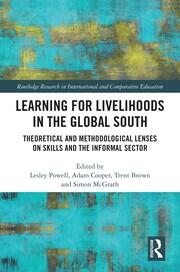
Learning for Livelihoods in the Global South Theoretical and Methodological Lenses on Skills and the Informal Sector
Foreword
Professor Leon Tikly
List of editors and contributors
Acknowledgements
1. Youth, skills, and informal sectors in the Global South: theoretical and methodological lenses on learning and livelihoods
Adam Cooper, Trent Brown, Lesley Powell and Simon McGrath
PART 1. Theorising: rethinking the purpose of education and training
2. A relational capabilitarian approach for wellbeing livelihoods: reframing and making alternative education, skills, and work for young people
Joan Dejaeghere
3. Subsumption, alienation, and questions of meaning in informal sector skills training
Trent Brown
4. Supporting youth livelihoods in an informal “sub‑ield” in the Global South
Adam Cooper
PART 2. Conceptualising: conceptual tools for understanding informal sector skill acquisition in practice
5. Shifting informal geographies and the hustle for a better future
David Monk and George Ladaah Openjuru
6. A typology of informal sector workers – heterogeneity and the complexity of skills development responses
Lesley Powell and Simon McGrath
7. The potential role of ICT in facilitating learning for livelihoods among informal apprentices in the automotive trade in Ghana
Joyceline Alla-Mensah and Eric Addae-Kyeremeh
8. Highly educated migrants in platform‑mediated food delivery work in the Netherlands: the absent presence of skills and its social effects
Roy Huijsmans
PART 3. Critiquing: understanding constraints and weaknesses in dominant appro
9. Exploring ‘valuable’ knowledge, skills, and attitudes: perceptions of young people in an informal settlement in Pietermaritzburg
Thandi Gumbi and Anne Harley
10. Critiquing the concept of ‘self‑reliance’ in informal sector training: a case study of Afghan refugee women in India
Namita Sharma and Preeti Dagar
11. Gendering decent work: rethinking the connections between informality, TVET, and gender through the ‘Decent Work’ agenda in Sierra Leone and Cameroon
Ross Wignall, Brigitte Piquard and Emily Joel
PART 4. Advocating: towards reform of policy and practice
12. Financing skills and lifelong learning in the informal sector
Robert Palmer
13. Exploring the intersectionality of green skills, innovation, and livelihoods in the informal economy in Harare, Zimbabwe
Tarisai Kudakwashe Manyati, Billy Kalima, Morgen Mutsau and Temitope J. Owolabi
14. Recognising Colombian waste pickers as public service providers and producers of knowledge
Federico Parra
PART 5. Concluding: moving forward
15. Skill and livelihoods: some concluding ideas
Simon McGrath
Biography
Lesley Powell is Associate Professor in the School of Education at the University of Cape Town, South Africa.
Adam Cooper is chief research specialist in the Equitable Education and Economies Research Division, Human Sciences Research Council of South Africa.
Trent Brown is Associate Professor at Tokyo College at the University of Tokyo, Japan.
Simon McGrath holds the established chair in Education at the University of Glasgow, UK.
‘Learning for informal sector livelihoods is highly relevant worldwide; yet, we know little about the topic from a scientific perspective. This book makes major contributions to closing this research gap. It is a “must read” for scholars and practitioners focused on skill acquisition in the Global South.’
Matthias Pilz, Faculty of Management, Economics and Social Sciences, University of Cologne, Germany
