




1st Edition
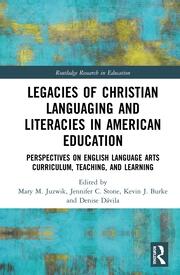
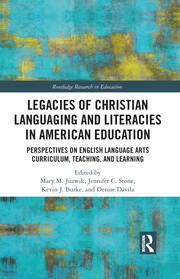
Legacies of Christian Languaging and Literacies in American Education Perspectives on English Language Arts Curriculum, Teaching, and Learning
01 Contributor Bio
02 Acknowledgements
03 Foreword
04 Introduction: Legacies of Christian Languaging and Literacies in American Education
Mary M. Juzwik, Kevin J. Burke, Jennifer C. Stone, and Denise Dávila
1.0 Section 1
Babel: Conversation, Conflict, and Contested Terrains of Schooling
Jennifer C. Stone, Editor
1.1, Chapter 1, "Real Religion": The Roles of Knowledge, Dialogue, and Sense-Making in Coming to a Faith
Allison Skerrett
1.2, Chapter 2, Recognizing Religion with Preservice Teachers
Heidi Hadley and Will Fassbender
1.3, Chapter 3, Institutional Rituals as Interpersonal Verbal Rituals as Interactional Resources in Classroom Talk
Robert LeBlanc
2.0 Section 2
Purity: Making Present the Stranger
Kevin J. Burke, Editor
2.1, Chapter 4, Myth and Christian Reading Practice in English Teaching
Scott Jarvie
2.2, Chapter 5, "Racism is a God-damned thing": The Implications of Historical and Contemporary Catholic Racism for ELA Classrooms
Mary L. Neville
2.3, Chapter 6, Regulating Language: Language Policies of Early American Christian Missions in Alaska
Jennifer C. Stone, Samantha Mack, Jacob D. Holley-Kline, and Mitchell Hoback
2.4, Chapter 7, A Dream Come True: Young Evangelical Womens’ Negotiations of Dreams, Reality, and Ideologies on Pinterest
Bree Straayer-Gannon
3.0 Section 3
Wisdom: Loving God, Loving our Neighbors, and Engaging Religious Pluralism through Literary Response
Mary M. Juzwik, Editor
3.1, Chapter 8, Entering into Literary Communion: Nourishing the Soul and Reclaiming Mystery through Reading
Kati Macaluso
3.2, Chapter 9, "Love your Neighbor": LGBTQ Social Justice and the Youth Canon of WWII Literature
Denise Dávila and Elouise E. Epstein
3.3., Chapter 10, Disrupting Protestant Dominion: Middle School Affirmations of Diverse Religious Images in Community Spaces
Denise Dávila and Allison Volz
4.0 Section 4
Resurrection
Denise Davila, Editor
4.1, Chapter 11, Ambivalence in Two Parts: Legacies of Catholic Languaging
Adam J. Greteman
4.2, Chapter 12, Multilingual, Multimodal, and Cosmopolitan Dimensions of Two Young Cuban-American Women’s Religious Literacies
Natasha Perez
4.3, Chapter 13, I had to die to live again: A racial storytelling of a Black Male English Educator’s Spiritual Literacies and Practices
Lamar L. Johnson
4.4, Chapter 14, (Re)Mystifying Literary Pedagogy
Mary M. Juzwik
Afterword
Biography
Mary M. Juzwik is Professor in the departments of Teacher Education and English at Michigan State University, USA.
Jennifer C. Stone is Professor of English at the University of Alaska Anchorage, USA.
Kevin J. Burke is Associate Professor of English Education in the Department of Language and Literacy Education at the University of Georgia, USA.
Denise Dávila is Assistant Professor of Literacy and Children’s Literature in the Language and Literacy Studies program at the University of Texas at Austin, USA.
