




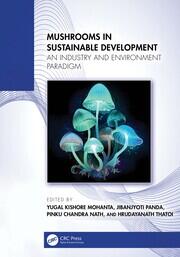
1st Edition
Mushrooms in Sustainable Development An Industry and Environment Paradigm
1. Mushroom Diversity and Their Role in Sustainable Development
Kuno Chuzho, Renald Blundell, and Yugal Kishore Mohanta
2. Mushrooms as a Bio-Factory of Sustainable Development
Swastik Behera, Prateek Ranjan Behera, Meenakshi, B. Rabi Prasad, Diptikanta Acharya, Prabhakar Singh, and Srimay Pradhan
3. Mushroom Bioactive Compounds as Therapeutic Potential
Smita Behera, Chandra Sekhar Tripathy, Santosh Kumar Behera, Akashi Borah, Shibani Mohapatra, and Jibanjyoti Panda
4. Mushroom in Food and Nutraceutical Applications
Niraj Singh, Setu Chakrabarty, and N. Seema Devi
5. Mushroom Polyphenols and Their Sustainable Applications
Uttara Mahapatra, Arnab Dutta, Harshit Gupta, Rattan Singh, and Pinku Chandra Nath
6. Mushrooms as a Sustainable Solution for Dietary and Therapeutic Protein: Managing Food Security with Sustainable Cultivation Practices
Neelam Amit Kungwani, Gunjan Sharma, Nitin Trivedi, Kalyani Vikhe, and Bishwambhar Mishra
7. Mushroom Based Sustainable Nano Biomaterial and Their Biomedical Application
Sameer Hussain, Qudsiya Y. Tamboli, Abdullah G. Al-Sehemi, Debasis Nayak, and Jibanjyoti Panda
8. Mushroom in Food Packaging Applications
Sohini Mukherjee, Pooja Mittal, Tanmoy Das, and Tanima Bhattacharya
9. Mushroom Heteropolysaccharides and Their Biological Effects
Umesh Chandra Dash, Satish Kanhar, and Sandeep Kumar Swain
10. Harnessing the Power of Mushroom Polysaccharides: Health Benefits and Therapeutic Potentials
CR Meera and Greeshma P V
11. Mushrooms Derived Industrial Enzymes and Their Applications
Deepa Goswami, Chanchal Mondal, Biswanath Bhunia, and Deepanka Saikia
12. Mushrooms as Biocontrol Agents: Alternate to Chemicals
C. Mahendranathan, F. T. Jonathan, and N. Kirushananth
13. Mushrooms Pigments in Sustainable Applications
Latha Rani R, Laikhuram Sarda Devi, Chingakham Sima Chanu, and Subra Dhar
14. Mushrooms as Functional Foods
Shubhankar Debnath, Tarun Kanti Bandyopadhyay, Biswanath Bhunia, Muthusivaramapandian Muthuraj, and K. R. Jolvis Pou
15. Mushrooms as Meat Substitutes
Biswajit Patra, Mihir Tanay Das, and Surya Narayan Pradhan
16. Mushrooms Waste Valorisation in Value-Added Products and Circular Economy
Amiya Ojha, Deeplina Das, and Tarun Kanti Bandyopadhyay
17. Mushrooms: A Promising Source for Industrial Use
Puja Roy, Rusmita Buragohain, Mohammad Zaki Shamim, Kuno Chuzho, and Jibanjyoti Panda
18. Mushroom: Ethical and Environmental Consideration in Industrial Applications
Abhishek Mohanta, Srimay Pradhan, Prabhakar Singh, and Sk Riyazat Khadim
Biography
Yugal Kishore Mohanta has more than six years of post-PhD teaching and research experience and currently holds the position of Assistant Professor at the Department of Applied Biology within the School of Biological Sciences at the University of Science and Technology Meghalaya (USTM), Meghalaya, India. He has extensive research experience in the fields of nanobiotechnology, microbiology, plant natural products, nutraceuticals, and SDGs. He has international research experiences as both a PhD visiting scholar and a postdoctoral fellow at KU Leuven, Belgium, and University of Nizwa, Sultanate of Oman, respectively. Furthermore, he has successfully published over 105 scientific articles (Q1/Q2/Q3), 5 edited books, 27 book chapters, and 2 Indian patents in his field of expertise and has garnered a total of 3843 citations, with an h-index of 35 and an i10 index of 76. He has established a research lab (NanoBioTraK_Lab) through the DST-ANRF grant (2022-24). Recently, he has received a grant for an international research network project sponsored by XJENZA MALTA, Government of Malta, in 2024-25. Additionally, he has served as a reviewer for over thirty international peer-reviewed journals and holds the position of Associate Editor for four SCIE-indexed journals. He is particularly interested in prioritizing the concept of translational research in the field of sustainable development. He is also acting as a Chief Coordinator in the Microbiologists’ Society India for the northeastern states of India to promote science and research. Presently, he is guiding three PhD students.
Pinku Chandra Nath graduated in Process and Food Engineering from Central Agricultural University (CAU) Imphal, India. He completed his master’s from Assam University Silchar (AUS), India and PhD from National Institute of Technology Agartala (NITA), Tripura, India. Presently, he has been working as an Assistant Professor (Research) at Research and Development Cell, Manav Rachna International Institute of Research and Studies (Deemed to be University), Faridabad, Haryana, India since 2024. He has more than 5 years of research experience in the areas of process development for value-added products from waste, formulation development and quality analysis of food products, production of bio-products using algal platform, and reaction engineering aspects on biodegradation studies at various reactors. He has published more than 30 papers in international peer-reviewed journals (Q1/Q2/Q3), 2 patents, 1 authored book, and more than 25 book chapters with an h-index of 14, i10-index of 20, more than 700 google scholar citations, and cumulative impact factor more than 150, first/corresponding author (>80%). Presently he is guiding 8 B.Sc., 4 M.Sc., and 2 PhD students. Also, he is serving as an editorial member and reviewer of several journals.
Jibanjyoti Panda completed his MS in Botany from North Orissa University (NOU), Government of Odisha, India, in the year 2014. He has also completed his M.Phil in Botany from Centurion University of Technology and Management, Odisha, India, in the year of 2019. Currently, he is working as a pre-doctoral scientist at the Department of Wildlife and Biodiversity Conservation, Maharaja Sriram Chandra Bhanja Deo University, Baripada, Mayurbhanj, Odisha, India. He possesses more than 9 years of research experience in the domains of microbiology, biotechnology, plant science, natural products, fermented food, waste valorization, mushroom biology, and SDGs. Furthermore, he Panda has extensive experience in mushroom technology, encompassing field surveys, collection, isolation, spawning, cultivation, mushroom bioactives, and nutraceuticals. He has also worked on numerous research projects funded by both the Government of Odisha and the Government of India, including those from the Department of Biotechnology (DBT) and the Department of Science and Technology (DST). He has effectively published more than 40 scientific publications, categorized as Q1, Q2, and Q3 journals (SCOPUS, SCIE) and one authored book on mushroom diversity in Bhubaneswar, Odisha, India.
Hrudayanath Thatoi currently serves as the Director of the Centre for Industrial Biotechnology Research (CIBR) at Siksha ‘O’ Anusandhan, a Deemed-to-be University in Bhubaneswar. Previously, he served as Chairman of the P.G. Council at Maharaja Sriram Chandra Bhanja Deo University (MSCBU), Baripada, and as a Professor and Head of the Department of Biotechnology at MSCBU. He has also worked as a mangrove biologist and Senior Scientist at the M.S. Swaminathan Research Foundation, Chennai. He has obtained his M.Sc., M.Phil., and PhD from Utkal University and has been serving as a faculty member in biotechnology since 2004. His teaching and research interests include molecular biology, industrial and pharmaceutical biotechnology, and microbiology. To date, he has published 25 books, including two textbooks, and more than 370 research papers in national and international journals, conference proceedings, and book chapters. He has also been awarded two patents. His research impact is reflected in his Google Scholar citations (10,870), h-index (52), and i10-index (128). He received the Samanta Chandra Sekhar Award in Life Science in 2021. He has been member of several microbiology and biotechnology societies and served as editorial member and reviewer of several international journals. He has also been recognized as one of the World’s Top 2% Scientists by Stanford University, USA.
