




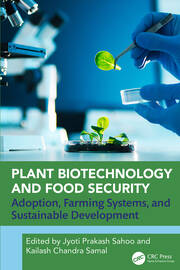
1st Edition
Plant Biotechnology and Food Security Adoption, Farming Systems, and Sustainable Development
Chapter 1: Traditional Farming and Modern Biotechnology: Bridging the Gap for Sustainable Agriculture
Pavitra Saini, Jyoti Singh, and Chintan Singh
Chapter 2: Genetically Modified Crops for Climate Change Adaptation
Hema Deupa and Priyanka Shankar
Chapter 3: Leveraging RNA Interference for Strengthening Crop Resilience to Biotic and Abiotic Stress Challenges
Solanki Bal
Chapter 4: Genome Editing in Crops for Climate Change Adaptation
Gaurav Sharma, Shivali Sharma, Dhanapati Keerthana, and Sunny Sharma
Chapter 5: Haploid Inducer-Mediated Genome Editing (HI-Edit) Technology for Climate Change
Desika J, Juliet Hepziba S, Deepa Dharsini, and Sree Vathsa Sagar U.S
Chapter 6: Next-Generation Sequencing and Crop Genomics for Climate Change Adaptation
Tanya Barpanda, Sourav Ranjan Nanda, Laxmipreeya Behera, Manasi Dash, and Abinash Mishra
Chapter 7: Molecular Breeding for Climate Change Adaptation in Crops
Siddhartha Shankar Sharma, Jannila Praveena, Sanghamitra Rout, Aninda Chakraborty, Debarati Nandi, and Manish Kumar Agrawal
Chapter 8: Integrating Biotechnology and Precision Agriculture for Plant Disease Management
Deepali Mohapatra, Lipikant Sahoo, Samikshya Sankalin Pradhan, and Biswajit Jena
Chapter 9: Addressing Global Nutritional Security Through Crop Biofortification
Prasann Kumar and Shipa Rani Dey
Chapter 10: Bioinformatics and Crop Improvement: Revolutionizing Plant Biotechnology in Achieving Food Security
A Sheena Sabatina and Renu Kumari
Chapter 11: Environmental Benefits of Biotech Crops
Swarnalata Tripathy, Binod Kumar Mahapatra, and Amruta Panda
Chapter 12: Biotechnology and Smallholder Farmers: Navigating Challenges and Unlocking Economic Pathways
Subrat Pattanaik, Arati Priyadarshini, and Basanta Kumar Samal
Chapter 13: Global Acceptance and Challenges of GMO-Free CRISPR/Cas9 Crops
Haragopal Dutta and Suman Dutta
Chapter 14: Integrating Biotechnology into Sustainable Agricultural Practices: Opportunities and Challenges
Surender Singh Chandel, Isha Sharma, Sonika Kalia, and Vinay Sharma
Chapter 15: Socio-Economic Implications of Biotech Innovations (GMOs Regulations): Ensuring Inclusivity and Sustainability
Shilpa Bahubalendra, Jeebanjyoti Behera, and Angelina Patro
Chapter 16: Opposition to Global Acceptance of Biotech Crops
Dhaarani Vijayakumar, Kousalya Loganathan, Manikandan Selvarasuvasuki, and Kanivalan Iwar
Chapter 17: Digital Agriculture and Biotechnology: Synergies for Sustainable Development
Sudhanya Nath and Sachin Tripura
Chapter 18: Nanobiotechnology Approaches for Climate Change Adaptation in Crops
Durgadatta Sahoo, D. Swapna, Amlan Mohanty, Barsharani Sethi, Parul Pratyasa Samal, Akankshya Mohapatra, and Jyoti Prakash Sahoo
Biography
Jyoti Prakash Sahoo is a dynamic researcher and academician currently serving as an Assistant Professor in the Faculty of Agriculture and Allied Sciences at C.V. Raman Global University, Bhubaneswar, India. He completed his M.Sc. (2016) and PhD (2023) in Agricultural Biotechnology from Assam Agricultural University, Jorhat, India and Odisha University of Agriculture and Technology (OUAT), Bhubaneswar, India respectively. His notable works include dissecting genetic architecture for Cercospora leaf spot and charcoal rot disease resistance in mung bean landraces, molecular breeding strategies for stress resilience in crops, sustainable management of viral pathogens in okra, and drought tolerance genetics in rice using microsatellite markers. He has guided 10 M.Sc. (Biotechnology) students. He regularly publishes in high-impact journals indexed by Scopus, UGC-CARE, and Clarivate, while also authoring important chapters for widely-referenced agricultural biotechnology books. He actively contributes as a peer reviewer for prestigious journals including Frontiers in Plant Science, BMC Genomics, Scientific Reports, and holds life memberships in professional societies including the Society of Biotechnology and Bioinformatics and Indian Society of Plant Breeders. His outstanding contributions to plant molecular biology and biotechnology have been recognized with prestigious honors, including the young scientist award (2021), the university best PhD thesis award of OUAT (2023), and multiple best oral presentation awards (2023) at national and international conferences.
Kailash Chandra Samal is the current Dean of the College of Horticulture at Odisha University of Agriculture and Technology (OUAT), Chiplima, India. He holds an M.Sc. in Agricultural Biotechnology from Tamil Nadu Agricultural University, Coimbatore, India (1991), and a PhD in Biotechnology from Utkal University, Bhubaneswar, India (2011). With 32 years of academic and research experience at OUAT, he has taught undergraduate, postgraduate, and PhD students while conducting pioneering research in plant molecular biology, plant tissue culture, microbial technology, DNA fingerprinting, and computational biology. He has developed cost-effective protocols for the large-scale micropropagation of several crops, including banana, ginger, turmeric, sugarcane, stevia, and sarpagandha. His work includes the development of molecular marker techniques for assessing the clonal fidelity of micro-propagated plants and the creation of a DNA fingerprint database for promising rice varieties in Odisha, India. He has studied the phenotypic, biochemical, and molecular characteristics of indigenous aromatic rice varieties from Odisha, India and molecular fingerprints of other crops such as ragi, wheat, rapeseed, sesame, black gram, green gram, eggplant, and tomato. He has guided 40 M.Sc. (Ag) and PhD students in molecular biology and biotechnology. He has also secured 10 externally funded projects from Department of Biotechnology (DBT), Rashtriya Krishi Vikas Yojana (RKVY), and the Ministry of Agriculture, Government of India. A member of several professional bodies, he has published 10 books and over 128 research papers. His research contributions include the isolation and characterization of abiotic stress-related genes such as DREB, deposited in GenBank (NCBI), USA.
