




1st Edition
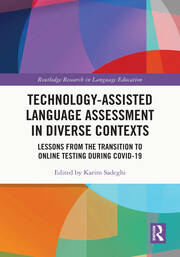
Technology-Assisted Language Assessment in Diverse Contexts Lessons from the Transition to Online Testing during COVID-19
Foreword by Paula Winke
Section I: Theoretical and Methodological Concerns in Online L2 Assessment
Chapter 1: Technology in language assessment: An overview
Karim Sadeghi
Chapter 2: Seeking empirical evidence to support online test validation: Building on the IELTS Indicator assessment model
Tony Clark, Martine Holland, and Richard Spiby
Chapter 3: Emergency remote assessment (ERA) narratives from the UK English for Academic Purposes (EAP) sector: Examining validity and longevity of technology-driven solutions
Emma Bruce and Heléna Stakounis
Chapter 4: Language testing and assessment in COVID-19 pandemic crisis
Hossein Farhady
Chapter 5: Argument-based validation in the time of the COVID-19 pandemic
Erik Voss
Chapter 6: Assessment without borders: Modernising placement tests for diverse contexts
Mahmoud Amer and María J. Cabrera-Puche
Section II: Reactions to L2 E-Assessment During the Covid-19 Pandemic
Chapter 7: Responding to the pandemic in New Zealand: Opportunities and challenges for language assessment in one tertiary institution
Martin East, Deborah Walker-Morrison, and Viviane Lelièvre-Lopes
Chapter 8: Online remote (at-home) assessment of language modules during COVID-19: Changes, challenges, and students’ perceptions
Isabel Balteiro
Chapter 9: Assessing university students’ writing development and performance during remote instruction
Bahiyyih Hardacre
Chapter 10: Fairness in remote English placement testing at Iowa State University during the COVID-19 pandemic
Reza Neiriz, Shireen Baghestani, Ananda Astrini Muhammad, and Jim Ranalli
Chapter 11: Integration of data-driven learning and assessment through a multimodal corpus of learning objects at the time of the COVID-19 pandemic
María Luisa Carrió-Pastor
Section III: Managing L2 Assessment at the Time of the Crisis: The Way Forward
Chapter 12: Test usefulness of E-Portfolios: An alternative approach during and beyond the pandemic
Ricky Lam
Chapter 13: Can interactions happen across the screens?: The use of videoconferencing technology in assessing second language pragmatic competence
Shishi Zhang and Talia Isaacs
Chapter 14: The use of technology for redesigning L2 language assessments: Tasks, rubrics, and feedback in emergency remote teaching contexts
Ana Maria Ducasse
Chapter 15: Rethinking the online placement test for a college-level Japanese language program during the COVID-19 pandemic
Akiko Imamura, Catherine Ryu, and Mariko Kawaguchi
Chapter 16: Conclusion: Lesson learned and lessons not learned
Karim Sadeghi
Biography
Karim Sadeghi is a Professor of TESOL at Urmia University, Iran. He is the founding editor-in-chief of the Iranian Journal of Language Teaching Research.
“This is a timely and interesting volume that will appeal to those interested in using technology in their instructional and assessment practices. It is a much-welcomed addition to the literature on technology-mediated language assessment. It also offers important guidelines for navigating assessment in different instructional settings in times of crisis. I strongly recommend this book!” - Atta Gebril, The American University in Cairo, Egypt
“This important book is both timely in its message and massively encouraging in the way in which the individual chapters reflect the creativity of language testers from across the world in dealing with the disruption caused by Covid. In challenging our perceptions of how to establish evidence of test quality in terms of development and delivery the authors call into question much current thinking on validation. Two strong messages ring out from these pages. The first relates to the need to broaden our validation evidence base to embrace qualitative as well as quantitative evidence. The second is the way in which context is rightfully recognised as a critical factor in any validation argument. This book should be seen as core reading for any language testing programme.” - Professor Barry O'Sullivan, British Council
"Technology-assisted language assessment has been with us for something like 40 years. One would think we know everything there is to know about it, but this is far from the case. As the authors of the various chapters document, technology-assisted language assessment is a complex undertaking with issues of the security of the test content itself and of the test-takers’ environment, fairness in terms of access to computers and the internet, validation concerns when test-takers may be unfamiliar with certain aspects of technology-assisted tasks, and reliability may be a challenge owing to diversity of test-taking situations and interaction between human and computer-based scoring. The chapters in this book address these concerns in a scholarly but approachable manner and readers will find much of value as they develop their own technology-assisted language assessments for their own contexts." - Dan Douglas, Professor Emeritus, Iowa State University, USA
"This timely edited collection of chapters addresses a critical matter of language assessment due to the COVID pandemic. It takes as its starting point the use of technology: online assessment, video technology, and remote learning. In addition, chapters provide overviews and opinions on validation and fairness during the pandemic. As editor, Sadeghi offers an overview as well as concluding thoughts of lessons learned and not learned. As repercussions of the COVID era are still unfolding, this collection will serve as a leading collection of ideas on technology and language assessment." - Professor Antony Kunnan, Nanyang Technological University, Singapore
