





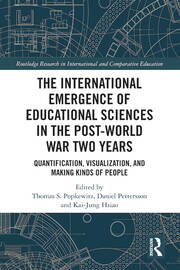
1st Edition
The International Emergence of Educational Sciences in the Post-World War Two Years Quantification, Visualization, and Making Kinds of People
Preface
Chapter 1: How Contemporary Educational Sciences Became Reasonable: The International Emergence of Educational Sciences in the Post-World War Two Years
Thomas S. Popkewitz, Daniel Pettersson, and Kai-Jung Hsiao
PART 1: MOBILIZING SCIENCE AND DESIRES FOR BETTER SOCIETIES
Chapter 2: Science as "the Beacon" for Social Change: The Reason of Systems in American Educational Research and Development
Thomas S. Popkewitz
Chapter 3: Tactile Pedagogies in the Postwar: Cybernetics, Art, and the Production of a New Educational Rationale
Inés Dussel
Chapter 4: Science as Utopia: Infrastructures, Pedagogies and the Prophecy of Design
Junzi Huang
PART 2: LOCATIONLESS LOGICS AND FABRICATING DIFFERENCES
Chapter 5: Post-World War Two Psychology, Education and the Creative Child: Fabricating Differences
Catarina Silva Martins
Chapter 6: Objectification of Human Nature: "Adolescent" as a Taxonomy of Postwar-Taiwan Actor
Kai-Jung Hsiao
Chapter 7: The Development of the Child and National Progress: Behaviorism and Cultural Deprivation in Brazil
Ana Laura Godinho Lima
Chapter 8: The Embrace of Systems in Post-World War Two Teacher Education Research
Sun Young Lee
PART 3: SYSTEMS, CYBERNETICS: IMAGINEERING BELONGING AS SOCIAL DIFFERENTIATION
Chapter 9: Diagrams of Feedback: Behaviorism, Programmed Instruction and Cybernetic Planning
Antti Saari
Chapter 10: From "Threat" to "Treat": Cybernetics in the Soviet Union
Tatiana Mikhaylova & Daniel Pettersson
Chapter 11: School Differentiation and Re-Forming Human Kinds in Swedish Welfare State Education after the Second World War
Gun-Britt Wärvik, Sverker Lindblad, Daniel Pettersson and Caroline Runesdotter
Chapter 12: Quantification of an Educational System: Numbers in the Social Differentiation of Brazil
Natália de Lacerda Gil
Index
Biography
Thomas S. Popkewitz is Professor of Curriculum and Instruction and the Holtz Center for Science & Technology Studies at the University of Wisconsin, Madison, USA.
Daniel Pettersson is Associate Professor in Pedagogy at the University of Gävle and Uppsala University, Sweden.
Kai-Jung Hsiao is a PhD student of Curriculum and Instruction at the University of Wisconsin, Madison, USA.
