





1st Edition
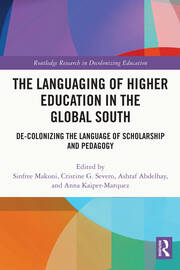
The Languaging of Higher Education in the Global South De-Colonizing the Language of Scholarship and Pedagogy
Introductory Chapter (Sinfree Makoni, Cristine Severo, Ashraf Abdelhay, Anna Kaiper-Marquez)
Part 1: Confronting Epistemological Language Issues
1. Global North Technocratic Discourse in Arab Higher Education: The Case of a North American Technical College in an Arab State (Samah Abdulhafid Gamar, Doha Institute for Graduate Studies)
2. Reflections on the Global North and Global South Engagement Initiative in Kinigi, Rwanda (Betty Sibongile Dlamini, Indiana University Bloomington, USA)
3. Polycentric or Pluricentric? Epistemic Traps in Sociolinguistic Approaches to Multilingual Portuguese (Clara Keating, School of Arts and Humanities and Center for Social Studies, University of Coimbra)
4. RE-. Vocabularies we live by in the Language and Educational Sciences (Sangeeta Bagga-Gupta, School of Education and Communication / Jönköping University, Sweden)
Part 2: Language Policy in Postcolonial Academic Contexts
5. Decolonizing Epistemology in Sudanese Linguistics: Integrationist and Political Perspectives (Mohammad Alkhair, Alzaim Alzhari University, Sudan; Abdel Rahim Mugaddam, Jouf University, Saudi Arabia)
6. Multilingualism at South African Universities: A Reflection from an Integrationist Perspective (Dumisile N Mkhize, College of Human sciences, University of South Africa, Department of English Studies)
7. ‘Everyone was Happy When Talking’: Revisiting the Use of Mother Tongues in Kenyan Universities (Vicky Khasandi-Telewa, Laikipia University, Kenya)
8. Existential Sociolinguistics: The Fundamentals of the Political Legitimacy of Linguistic Minority Rights (David M. Balosa, University of Maryland, Baltimore County)
Part 3: Languaging Pedagogy in Post-Secondary Contexts
9. Teaching Gender Awareness in Teacher Education through a Curriculum which De-Links from Abyssal Thinking (Liesel Hibbert, University of Stellenbosch, Faculty of Education)
10. Recontextualization of the Author’s and Reader’s Position in Simone De Beauvoir’s Le Deuxième Sexe in the Turkish Cultural Environment Through Translation (Ayşenaz Cengiz, Boğaziçi Üniversitesi, Turkey)
Part 4: Technology and Decolonial Practices
11. Languaging in Computer-Mediated Communication: Heteroglossia and Stylization in Online Education (Sibusiso Clifford Ndlangamandla, University of South Africa)
12. (How) Can Critical Posthumanism Help to Decolonize Tertiary Education in the South in the Age of Cognitive Capitalism? (Marcelo El Khouri Buzato, University of Campinas, Brazil)
13. Concluding Commentary (Felix Banda, Linguistics Department, University of the Western Cape)
Biography
Sinfree Makoni is Professor of Applied Linguistics at the Pennsylvania State University, US.
Cristine G. Severo is Associate Professor of Language Policy and Linguistics at the Federal University of Santa Catarina, Brazil.
Ashraf Abdelhay is Associate Professor of Sociolinguistics at the Doha Institute for Graduate Studies, Qatar.
Anna Kaiper-Marquez is Associate Director and Assistant Teaching Professor of the Institute for the Study of Adult Literacy and the Goodling Institute for Research in Family Literacy at Pennsylvania State University, US.
