





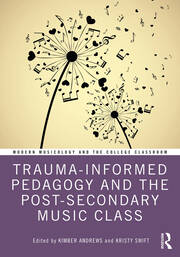
1st Edition
Trauma-Informed Pedagogy and the Post-Secondary Music Class
Table of Contents
Prologue: An Interview of Associate Vice Provost and Professor Keisha Love, University of Cincinnati
Introduction: Why Trauma-Informed Pedagogy in Post-Secondary Music?
Kimber Andrews and Kristy Swift
Part I: Responding to Uncertainty, Stress and Trauma Through and With Music
Kimber Andrews
Chapter 1—Transcending Notes: A Trauma-Informed Care in Music Education for Re-membering and Re-embracing Our Wholeness
Mays Imad
Chapter 2—Teaching Traumatized Students
Fred Maus
Chapter 3—These Are Magic Words: On Trauma-Informed Pedagogy in Ethnographic Fieldwork
Drew B. Griffin
Chapter 4—Designing Trauma-Informed Assessments in the Decolonised Music Classroom: UK and US Contexts
Michelle Meinhart
Chapter 5—Supporting Learners in the Possibility of Environmental Collapse: An Arts-Based and Trauma-Informed Course
Tawnya D. Smith
Chapter 6—Teaching Sound, Music, and Trauma
Kristy Swift
Part II: Intersectional Trauma–Informed Pedagogy and the Music Class
Kristy Swift
Chapter 7—Negotiating the Ambivalences of Safe Space through In-Class Open Mics
Ryan Lambe
Chapter 8––Trauma-informed and Universal-Design Approaches for Rigorous Training in Aural Skills
Samantha Bassler
Chapter 9––Antiracism as a Pedagogy of Care and Repair
John Spilker-Beed
Chapter 10––Trauma-Informed Vocal Pedagogy: Methods to Combat Racial Trauma in Black Singers Within the Vocal Studio
Brandi L. Diggs
Chapter 11––Becoming a Situated Ear: A Feminist, Trauma-Informed Approach to Aural Skills
Vivian Luong
Part III: Islands of Care: Cultivating Awareness, Connection, Growth, and Resilience
Kimber Andrews
Chapter 12—Creating the Container: Strategies for Building a Trauma-Informed, Nervous System-Aware Adult Learning Environment
Jennifer King and Sylvia Hernandez
Chapter 13—“Every Artist Is an Advocate”: Mentoring High-Achieving Students and Negotiating Institutional Pressure in Student Advocacy and Research
Holly Riley and Noah Durnell
Chapter 14—Staying Tuned In: Connecting Body and Brain to Deepen Understanding and Learning in the Music Classroom
Amy Stenger-Sullivan
Chapter 15—Firmly Grounded, So You Can Soar: How I Used Universal Design for Learning to Keep Teaching After Trauma
Nicol Hammond
Epilogue: Choice and Voice
Quinn Patrick Ankrum
Index
Biography
Kimber Andrews is an Associate Director at the Center for the Enhancement of Teaching and Learning at the University of Cincinnati.
Kristy Swift is Assistant Professor of Music Studies and Bachelor of Arts Music program director at the University of Cincinnati College-Conservatory of Music.
