





1st Edition
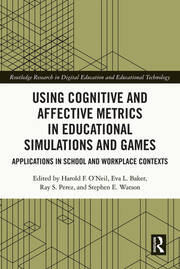
Using Cognitive and Affective Metrics in Educational Simulations and Games Applications in School and Workplace Contexts
Editors’ Preface
Part I: Cognitive Metrics
1. Video Games and Higher Cognition
Jocelyn Parong, Claire Holman, Emma Cunningham, C. Shawn Green, and Daphne Bavelier
2. Teaching and Assessing Young Gamers’ Engineering Problem Solving Using Interactive Simulation Games
Zenaida Aguirre-Muñoz
3. Adaptation Evidence From a Digital Physics Game
Elizabeth J. K. H. Redman, Gregory K. W. K. Chung, Tianying Feng, Katerina Schenke, Charles B. Parks, Joanne K. Michiuye, Sandy M. Chang, and Jeremy D. Roberts
Part II: Affective Metrics
4. Metrics of Motivation in Simulations or Game Environments
Robert Rueda
5. Metrics for Engagement in Games and Simulations for Learning
Benjamin D. Nye, Mark G. Core, Aviroop Ghosal, and Peter B. Walker
6. Measuring and Increasing Self-Efficacy in a Game
Harold F. O’Neil, Richard E. Mayer, Robert Rueda, and Eva L. Baker
7. Measuring and Increasing Interest in a Game
Katerina Schenke, Harold F. O’Neil, Eva L. Baker, and Stephen E. Watson
8. Metrics for Assessment in the Navy Life Game
Alan D. Koenig, Markus R. Iseli, John J. Lee, Jenny C. Kao, and Joanne K. Michiuye
Biography
Harold F. O’Neil is Professor of Educational Psychology and Technology in the Rossier School of Education, University of Southern California, US.
Eva L. Baker is a Distinguished Professor at UCLA and founding Director of CRESST, US.
Ray S. Perez is Program Officer of the Cognitive Science of Learning Program, Office of Naval Research, US.
Stephen E. Watson is Chief Inventor, Affinity Associates LLC, US.
