




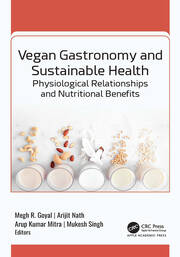
1st Edition
Vegan Gastronomy and Sustainable Health Physiological Relationships and Nutritional Benefits
Preface
PART I: Veganism
1. Veganism in Different Human Races
Aratrika Samajdar, Moubani Dutta, Saptamita Biswas, Samriddhi Golder, and Krittika Sah
2. Phylogenetic History of Vegan Homo sapiens to Omnivores
Sanjana Ghosh, Soumyadip Biswas, Stootee Baruah, Shreenanda De, Arup Kumar Mitra, Sudeshna Shyam Choudhury, and Ayan Chandra
3. Veganism and Integral Health
Ayush Bhattacharya, Swayambhik Mukherjee, and Surya Sarathi Das
PART II: Legumes in Vegan Diet
4. Legumes: A Sustainable Source of Protein for Human Diets in Asian Countries
Srijita Paul, Archit Bhattacharya, Meenakshi Mukhopadhyay, and Arup Kumar Mitra
5. Legumes as an Alternative to Animal-Based Protein
Moumita Maity, Arpita Tripathy Panda, and Ranjay Kumar Thakur
6. Consideration of Leguminous Proteins: From Traditional to Unusual
Lívia Hajas, Réka Juhász, and Csilla Benedek
PART III: Edible Mushrooms and Health Benefits
7. Role of Mushroom in Diet Toward Healthy Life
Rishav Kundu, Debjeet Chakraborty, Oushnik Sen Gupta, Subhrodeep Paul, Pratyasha Majumder, Bikram Dhara, and Arup Kumar Mitra
8. Edible Mushrooms: An Alternative Source of Nutritious Food and Its Health Benefits
Ranjay Kumar Thakur, Ankita Das, and Garima Soni
9. Nutritional Value of Mushroom Varieties in India
Atreyee Banerjee, Shewantika Das, Sudeshna Shyam Choudhury, and Arup Kumar Mitra
PART IV: Veganism and Sustainable Health
10. Vegan Diet as a Comprehensive Management Strategy for Cancer
Debapriya Maitra, Ronit Dey, Sylvia Denis, Zubia Zain, Talaha Nishat Ahmed, Sudeshna Shyam Choudhury, and Arup Kumar Mitra
11. Vegan to Vigor: Role of Plant-Based Diet in Post-COVID Recovery
Aniket Mookerjee, Debalina Saha, Atasi Hazra, Pritam Kanjilal, and Arup Kumar Mitra
12. Vegan Diet as a Tool to Combat Obesity
Bidisha Chatterjee, Adrija Banerjee, Deepsikha Chatterjee, Doyel Chatterjee, Sharadia Dey, and Arup Kumar Mitra
PART IV: Prebiotics and Probiotics in Vegan Diet
13. Plant-Based Essential Fatty-Acids and Ketogenic Vegan Diet
Blanka Vékony, Réka Juhász, Lívia Hajas, Csilla Benedek, and Zsanett Bodor
14. Health Benefits of Prebiotics in Vegan Diets
Swati Ray
15. Vegan Diet Practice and Its Influence on Human Gut Microbiome: A Review
Bedaprana Roy, Shewantika Das, Saranya Trivedi, Stootee Baruah, Hena Khamaru, Shubhangi Dutta, Rithik Wilson, Jaydip Ghosh, and Arup Kumar Mitra
Index
Biography
Megh R. Goyal, PhD, PE, is a retired Professor in Agricultural and Biomedical Engineering from the General Engineering Department in the College of Engineering at the University of Puerto Rico–Mayaguez Campus. He has worked as a Soil Conservation Inspector and as a Research Assistant at Haryana Agricultural University and Ohio State University. He was the first agricultural engineer to receive the professional license in Agricultural Engineering from the College of Engineers and Surveyors of Puerto Rico and was proclaimed as the “Father of Irrigation Engineering in Puerto Rico for the twentieth century” by the ASABE, Puerto Rico Section, for his pioneering work on micro irrigation, evapotranspiration, agroclimatology, and soil and water engineering. During his professional career of over 52 years, he has received many prestigious awards. A prolific author and editor, he has written more than 200 journal articles and several textbooks and has edited over 100 books.
Arijit Nath, PhD, is currently a Senior Research Associate in the Department of Food Process Engineering, Institute of Food Science and Technology, Hungarian University of Agriculture and Life Sciences, Budapest, Hungary. He has received habilitation in food science from the Hungarian University of Agriculture and Life Sciences (MATE), Hungary. He received a doctorate of Philosophy in Chemical Engineering. He has published 35 research and review articles in international journals, 13 book chapters, and two books. Dr. Nath has also presented his research outcomes at more than 90 international conferences and 15 conferences within India, where he has received several best presenter awards. He has also delivered lectures at several scientific communities and acted as a resource person for international conferences. Due to his strong proficiency in the field of biochemical and food engineering, Dr. Nath has served as an editor in various SCI books and journals and has served as a reviewer for several SCI journals. Dr. Nath is a member of several scientific communities. His research topics are fermentation technology, enzymatic reaction, probiotics and prebiotics, allergy-free food products, valorization of food waste, membrane-based bioprocess, environmental benign processes, and mathematical modeling of bioprocesses. During his PhD tenure, Dr. Nath was a senior research fellow, supported by Council of Scientific and Industrial Research (CSIR), India and project research fellow, supported by University Grants Commission (UGC), India.
Arup Kumar Mitra, PhD, is an Associate Professor in the Department of Microbiology and also the Head of the Department of Environmental Studies at St. Xaviers College (Autonomous), Kolkata, India, where he has also been serving as the Controller of Examinations since 2021. Dr. Mitra has two patents and has submitted 68 genetic sequences to the National Center for Biotechnology Information (NCBI). He has written and edited over 70 books and book chapters. He has published books in various fields, including biology, botany, environmental science, and microbiology. In addition, Dr. Mitra has published more than 50 research and review articles in peer-reviewed journals under Science Citation Index (SCI). He has also worked as a resource person for many seminars and webinars and has been honored with various awards for his work. Dr. Mitra has successfully undertaken 15 major and minor projects funded by the University Grants Commission (UGC), Department of Biotechnology under Ministry of Science and Technology (DBT), Department of Science and Technology (DST) and Council of Scientific and Industrial Research (CSIR), India. Several students have been awarded their PhD degrees under his supervision. His fields of research interests include air, water, and soil microbiology. He has been a life member of various Indian scientific communities. He earned his PhD in Science from the University of Calcutta, India. He also holds a diploma in environmental monitoring and assessment from South Bank University, London.
Mukesh Singh, PhD, has been working as a Principal and faculty member of the Department of Botany, Kabi Nazrul College in Birbhum, West Bengal, India, since September 2023. Previously, Dr. Singh was an Associate Professor in the Department of Biotechnology, Haldia Institute of Technology, West Bengal, India. He has more than 18 years of teaching experience in biotechnology. He has supervised over 100 undergraduate and postgraduate dissertations and three PhD students, which several now students continuing their PhD research work under his supervision. Dr. Singh has published research activities in nearly 40 SCI-indexed international repute journals, 12 book chapters and three books. Furthermore, he presented his research outcomes at more than 70 international and national conferences. Due to his research excellence, Dr. Singh has received best presenter awards at several conferences in India. In addition, he participated in workshops, professional training programs, and delivered lectures in a wide range of fields, including tissue culture, genetics, bioinformatics, food science, and biotechnology. He is a member of various Indian scientific communities. His research topics include metagenomics, nanobiotechnology, enzymology, bioactive compounds from plant, food waste valorization, environmental toxicology and bioremediation. After completing his postgraduate in genetics and plant breeding from the University of Calcutta in 2001, he received PhD in science in the field of Biochemistry and Genetics from Jadavpur University, India, in 2006.
