





1st Edition
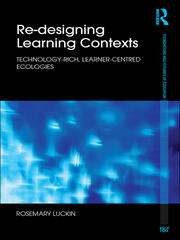
Re-Designing Learning Contexts Technology-Rich, Learner-Centred Ecologies
Part One: Background 1. Contexts for Learning 2. Learners and Learning 3. The Role of Technology Part Two: The Ecology of Resources Model and Design Framework 4. Software Design and the Zone of Proximal Adjustment 5. Modelling a Learner's Context 6. The Ecology of Resources Method: Models and Participatory Design 7. The Ecology of Resources Design Framework Part Three: The Future of Technology Rich Learning 8. New Technologies, New Interactions? 9. New Interactions, New Opportunities for Learning
Biography
Rosemary Luckin is Professor of Learner-Centred Design at the London Knowledge Lab, Institute of Education, University of London, UK. She has graduate and postgraduate qualifications in Artificial Intelligence and Cognitive Science and has taught learners in schools, colleges and universities.
'One of the most important contributions on the whole TEL field.' – Richard Noss, Director of ESRC/EPSRC TEL Research Program
'As new technologies, tools and online resources continue to proliferate, teachers, children and parents are increasingly confronted with 'learning support' overload. From smartphones to multitouch, apps to augmented reality, and interactive books to YouTube – how do they decide which to use and also how best to integrate with existing learning practices? Luckin's seminal and timely text covers the wider 'context of learning' spanning across time, space, home and school, while also crossing local and global and virtual and physical. A must read for those who want to learn more about how best to systematically choose, combine and constrain in an increasingly unwieldy world of instant knowledge and pervasive technology.' – Prof. Yvonne Rogers, Professor of Human-Computer Interaction, Oxford University
