




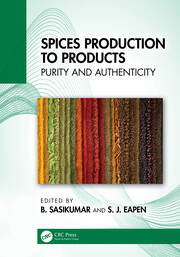
1st Edition
Spices Production to Products Purity and Authenticity
PART I INTRODUCTION: FOUNDATIONS OF SPICE INTEGRITY
1. Historical Perspectives on Adulteration and Contamination of Spices
B. Sasikumar and Santhosh J. Eapen
2. Introduction to Spice Adulteration and Authenticity Testing
H.D. Khade and Prasad S. Variyar
3. Global Standards and Regulations of Spice Purity
Admajith M. Kaimal, Samrin Kabir, and Rekha S. Singhal
PART II ADULTERATION AND AUTHENTICITY: SAFEGUARDING SPICE PURITY
4. Adulteration and Authenticity Testing in Black Pepper (Piper nigrum L.)
S.R. Maneesha, I.P. Vijesh Kumar, T.E. Sheeja, and B. Sasikumar
5. Adulteration and Authenticity Testing of Chilli (Capsicum spp.)
Arshita Verma, Somnath Basak, and Rekha S. Singhal
6. Adulteration and Authenticity Testing of Nutmeg (Myristica fragrans Houtt.)
Aditi Negi, P. Paulin Patricia, R.G. Reshma, M. Loganathan, and R. Meenatchi
7. Saffron (Crocus sativus L.) Analysis: Techniques for Quality Assurance and Authentication
Leena Kumari and S. Swarupa Tripathy
8. Advances in Adulteration and Authenticity Testing of Ginger (Zingiber officinale Roscoe)
B. Sasikumar
9. Advances in Adulteration and Authenticity Testing of Turmeric (Curcuma longa L.)
B. Sasikumar
PART III MYCOTOXIN AND OTHER CONTAMINANTS: CHALLENGES AND SOLUTIONS
10. Mycotoxin Contamination in Black Pepper (Piper nigrum L.)
R. Suseela Bhai and E. Jayasree
11. Mycotoxin Contamination in Cardamom (Elettaria cardamomum (L.) Maton)
K. A. Saju and K. Dhanapal
12. Mycotoxin Contamination in Ginger (Zingiber officinale Rosc.) and Turmeric (Curcuma longa L.)
B. Chempakam and S. Sindhu
13. Contaminants in Nutmeg (Myristica fragrans Houtt.)
B. Sasikumar
14. Mycotoxin Contamination in Seed Spices
M.K. Mahatma, Kailashpati Tripathi, and Y.K. Sharma
15. Heavy Metal Contamination in Spices: Sources, Safety Regulations and Health Implications
Seema Mishra, Nishtha Mishra, Aseem Trivedi, and Sanjay Dwivedi
PART IV PESTICIDE RESIDUES: DETECTION AND CONTROL
16. Pesticide Contamination in Black Pepper (Piper nigrum L.): Detection, Implications, and Sustainable Solutions
Chellappa M. Senthilkumar and Santhosh J. Eapen
17. Pesticide Residues in Chilli (Capsicum annuum L.): An Indian Perspective
Vandana Tripathy, Vipin K. Maikhuri, Kesar Tandekar, Ruchi Gupta, and Suresh Walia
18. Multi-residue Pesticides in Ginger (Zingiber officinale Roscoe) and Turmeric (Curcuma longa L.): Method of Analysis and Strategy for Residue Management
Pushpa Deore, Atul Baliram Khalangre, Vrushali Bhanbhane, and T.P. Ahammed Shabeer
19. Multi-Residue Pesticides in Seed Spices: Rationale for Analysis and Management Strategies
Atul Baliram Khalangre, Sachin Chandrakant Ekatpure, Harshad Bandu Mhamane, and Thekkumpurath. Ahammed Shabeer
PART V CONSUMER AWARENESS AND SUSTAINABLE SUPPLY CHAINS
20. Consumer Awareness and Market Demands in Global Spice Value Chains
Lijo Thomas and V.K. Sajesh
21. Sustainability and Ethical Sourcing of Spices
Ram Kumar Menon, Madhuri Nanda, and Saurabh Sinha
Biography
Dr. B. Sasikumar, who holds a Ph.D. in Plant Breeding from Anand Agricultural University, Gujarat, with post-doctoral training in Plant Molecular Biology from the School of Biotechnology, Madurai Kamaraj University, Tamil Nadu, India, as well as the Plant Biotechnology Institute, NRC-Canada, brings 33 years of experience in spices breeding, genetic resources, and adulteration detection of spices using molecular tools. He retired as Principal Scientist and Head, Crop Improvement and Biotechnology Division at ICAR-Indian Institute of Spices Research, Kozhikode, Kerala, India.
Dr. Sasikumar is currently a member of the Scientific Panel on Spices and Culinary Herbs of the Food Safety and Standards Authority of India (FSSAI). A decorated science communicator, he has published 127 research articles, 16 review articles, 16 book chapters, and approximately 400 popular articles on various aspects of spices, including adulteration detection, varieties, genetic resources, and success stories.
He is credited with developing 13 acclaimed varieties of spices, most of which have been well received by stakeholders in India. Dr. Sasikumar is internationally recognized as a spice specialist and has been featured in Stanford University’s 2023 and 2024 lists of the world’s top 2% scientists. He served as Spices Expert in Guyana, South America, for two years and also visited Vietnam and Nepal for spice consultancy and research.
Dr. S. J. Eapen, an alumnus of Calicut University, is a leading expert in spice research in India, with a career spanning over three decades. He has held prestigious roles, including Principal Scientist and Head at ICAR-Indian Institute of Spices Research and President of the Indian Society for Spices. In these roles, he led initiatives that elevated both the scientific and industrial standards of the spice sector. His expertise covers research management, crop protection, nematology, and bioinformatics, establishing him as a key figure in developing sustainable agricultural practices for spice cultivation.
Throughout his distinguished career, Dr. Eapen has authored numerous research papers, reviews, and book chapters. As a passionate writer, he regularly blogs about science and technology, including the integration of AI in scientific research. His work includes the development of disease-resistant spice varieties, and he holds patents for biocontrol formulations that advance environmentally sustainable pest management strategies in agriculture.
Dr. Eapen’s international influence extends beyond India. He has served as a nematology consultant in Vietnam and chaired scientific committees in Malaysia, contributing to the global exchange of knowledge in his field. Currently, he serves as a member of the FSSAI Scientific Panel on Pesticide Residues, shaping national policies on pesticide residues and ensuring their alignment with international standards. As Advisor to the World Spice Organisation, he collaborates closely with the global spice industry, and as a mentor for the Kerala Startup Mission, he guides young entrepreneurs and fosters innovation in the spice and agricultural sectors. His contributions continue to shape the future of spice research and industry both in India and internationally.
